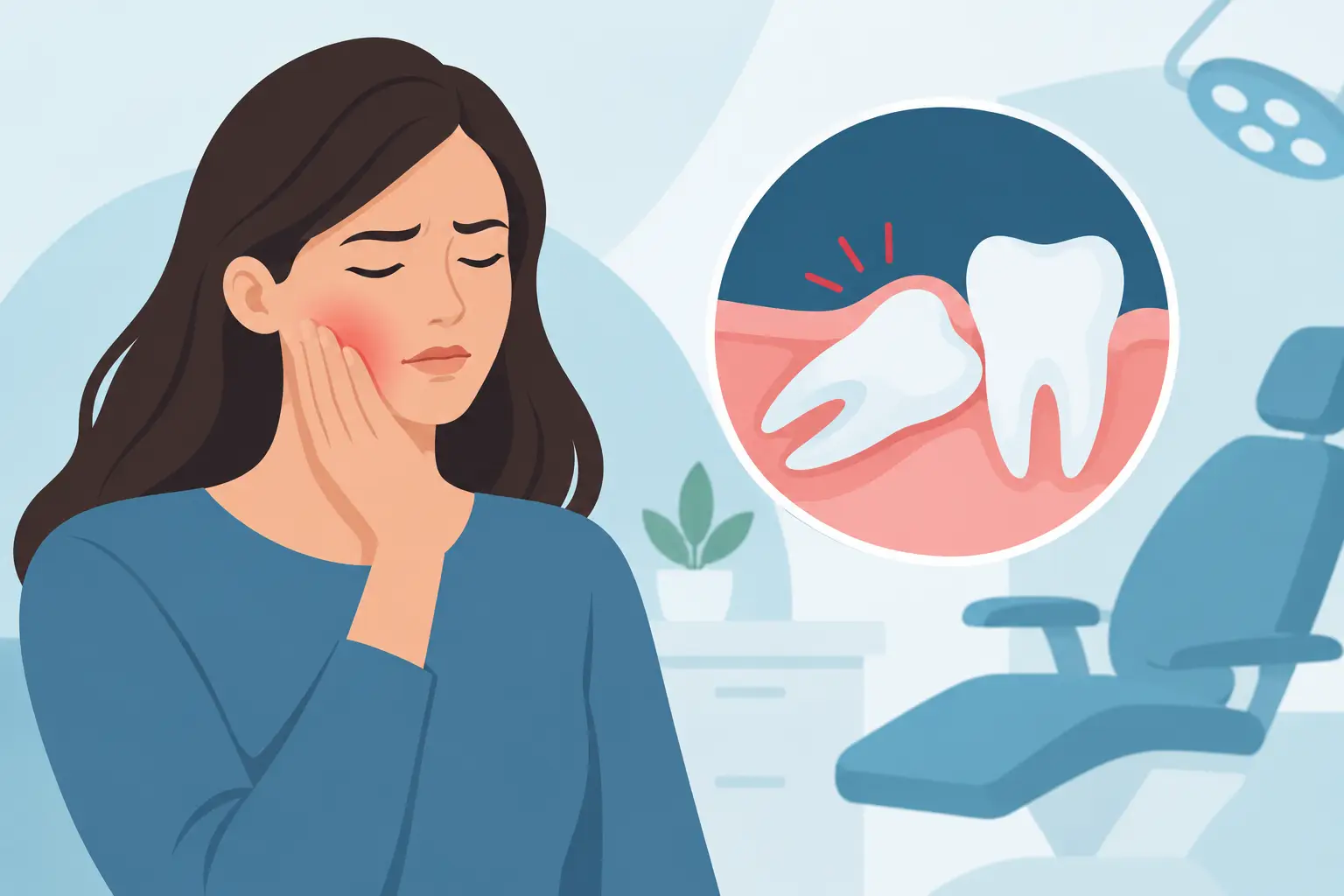
A dull ache at the back of the jaw, swelling around a partially erupted tooth, or pain when chewing can make wisdom teeth difficult to ignore. Yet not every wisdom tooth needs to be removed. The right decision depends on its position, the health of the surrounding gum and neighbouring tooth, your symptoms, and what can be seen on a detailed clinical examination and X-ray.
Wisdom teeth are the last molars to develop, usually appearing between the late teens and mid-twenties. Some erupt fully, sit comfortably in the bite and can be cleaned effectively. Others remain trapped beneath the gum or bone, emerge only part way, or lean towards the tooth in front. It is these positions that can create repeated problems over time.
Why wisdom teeth become a problem
The modern jaw does not always have enough room for four additional molars. When a wisdom tooth cannot erupt into a functional, cleanable position, food debris and bacteria may collect around it. A partially erupted lower wisdom tooth is especially prone to this because a flap of gum can sit over part of the tooth.
This may lead to pericoronitis, an infection and inflammation of the gum around the erupting tooth. It can cause tenderness, bad taste, swelling, difficulty opening the mouth and pain that travels towards the ear or throat. Symptoms can settle temporarily, then return. Repeated episodes are a good reason to arrange a surgical assessment rather than relying on short-term relief alone.
An impacted wisdom tooth may also damage the tooth beside it. Pressure, decay where the two teeth meet, gum disease or loss of bone around the second molar can develop quietly, often before there is significant pain. In some cases, a cyst can form around an unerupted tooth. These outcomes are uncommon, but they are precisely why careful monitoring matters.
Crowding at the front of the mouth is often blamed on wisdom teeth. The reality is more nuanced. Teeth can shift naturally throughout adulthood, and removing wisdom teeth is not a reliable treatment for existing crowding. If you are concerned about changes in tooth alignment, an orthodontic assessment is more useful than assuming the wisdom teeth are the cause.
When removal may be recommended
Removal is usually considered when a wisdom tooth is causing pain, recurrent infection, decay, gum disease, damage to the adjacent tooth, or a cyst-like change visible on imaging. It may also be recommended where the tooth is unlikely ever to erupt into a healthy position and its location creates a clear future risk.
The decision is not based on a single X-ray alone. Your clinician will consider the angle of the tooth, the amount of available space, the condition of the tooth in front, your medical history and the anatomy around the roots. For lower wisdom teeth, the relationship between the roots and the nerve that supplies feeling to the lower lip and chin is particularly important. If the roots appear close to this nerve, three-dimensional imaging may be advised to plan treatment accurately and discuss the safest approach.
Sometimes the best course is observation. A fully erupted, symptom-free wisdom tooth that is healthy and easy to clean may simply be reviewed as part of routine dental care. Preventive removal is not automatically necessary for every unerupted tooth either. Surgery has benefits where there is disease or a meaningful risk of harm, but it also involves recovery time and recognised surgical risks. A personalised recommendation is better than a one-size-fits-all rule.
Signs that need prompt assessment
Severe pain, facial swelling, fever, difficulty swallowing, increasing difficulty opening your mouth, or feeling generally unwell can indicate a spreading infection. These symptoms need urgent dental assessment. If swelling affects breathing or swallowing, seek emergency medical help immediately.
Less dramatic symptoms still deserve attention. Persistent soreness at the back of the jaw, bleeding gums around the tooth, a recurring unpleasant taste, food constantly catching in one area, or pain when biting may point to a problem that will not resolve without treatment. A short course of antibiotics may occasionally be appropriate where infection is present, but antibiotics do not remove the underlying cause. Definitive care often involves cleaning, gum management or removal of the tooth, depending on the findings.
What happens during a wisdom teeth consultation
A surgical consultation should give you clarity, not pressure. Your dentist or oral surgeon will ask about your symptoms, previous infections, general health and medications. They will examine the gums, mouth opening and neighbouring teeth, then assess appropriate X-rays.
You should leave understanding whether the tooth can be maintained, why removal is or is not advised, and what the procedure is likely to involve. For straightforward erupted teeth, extraction can be similar to removing another molar. Impacted teeth can require a more surgical approach, with a small incision in the gum and, where necessary, careful removal of a small amount of bone or sectioning of the tooth to avoid unnecessary force.
Local anaesthetic is used to ensure the area is fully numb. You may feel pressure and movement, but should not feel sharp pain. For patients who are particularly anxious, discussing this early is valuable. A calm, well-paced appointment, clear explanations and appropriate options for anxiety management can make a significant difference to the experience.
At Slievemore Dental, wisdom tooth treatment is planned with the same attention to detail as other oral-surgery care: precise imaging, careful assessment of anatomy and a focus on comfort before, during and after treatment.
Recovery after wisdom teeth removal
Recovery varies with the complexity of the extraction. Many people return to normal daily activities within a few days after a simple extraction, while surgical lower wisdom tooth removal can involve swelling, jaw stiffness and tenderness for a week or longer. Plan some quiet time, particularly for the first 48 to 72 hours.
Follow the post-operative instructions provided by your clinician. These commonly include biting on gauze initially, taking prescribed or recommended pain relief as directed, using a cold pack externally in the first day, eating soft foods and keeping the mouth clean without disturbing the socket. Avoid smoking, vaping, alcohol and vigorous rinsing during the early healing phase, as these can interfere with the blood clot that protects the extraction site.
Dry socket occurs when that protective clot is lost or breaks down too early. It is more likely after lower wisdom tooth removal and can cause increasing pain a few days after surgery, often with an unpleasant taste or odour. It is treatable, but contact the practice rather than trying to manage severe or worsening pain at home.
A small amount of swelling and bruising can be expected. However, worsening swelling after several days, persistent bleeding, fever, numbness that concerns you, or pain not controlled by the advised medication should be reviewed promptly.
Looking after the teeth you keep
A wisdom tooth that stays in place needs the same standard of care as every other tooth, with extra attention to the hard-to-reach back corners of the mouth. A small-headed toothbrush, fluoride toothpaste and daily interdental cleaning can help, but no home routine can compensate for a tooth that is inaccessible or repeatedly inflamed.
Regular examinations allow subtle changes to be identified before they become painful or threaten the neighbouring molar. For many patients, that is the real value of an assessment: not simply deciding whether to remove a wisdom tooth today, but protecting the long-term health, comfort and function of the teeth around it.
If a back tooth is becoming painful, swollen or difficult to clean, arranging an assessment early usually gives you more options and a calmer path forward.