When several teeth are missing, the choice is rarely as simple as “dentures or implants”. An implant denture comparison is about understanding how each solution feels in daily life, how it is maintained, what treatment involves and which option best protects your comfort, confidence and oral health over time.
For some patients, a removable implant-retained denture offers a major improvement in stability without the commitment of a fixed bridge. For others, a fixed full-arch restoration provides the closest experience to having natural teeth again. The right answer depends on your bone levels, medical history, bite, aesthetic goals, budget and how much day-to-day maintenance feels realistic for you.
Implant Denture Comparison: The Main Options
Dental implants are small titanium fixtures placed into the jawbone to replace tooth roots. Once healed, they can support a denture, bridge or full-arch restoration. Unlike a conventional denture, which sits on the gums, an implant-supported solution gains its stability from carefully positioned implants.
The two most common full-arch choices are a removable implant-retained denture and a fixed implant bridge, often known as an All-on-X restoration. Both can transform function and appearance, but they suit different priorities.
Implant-retained removable dentures
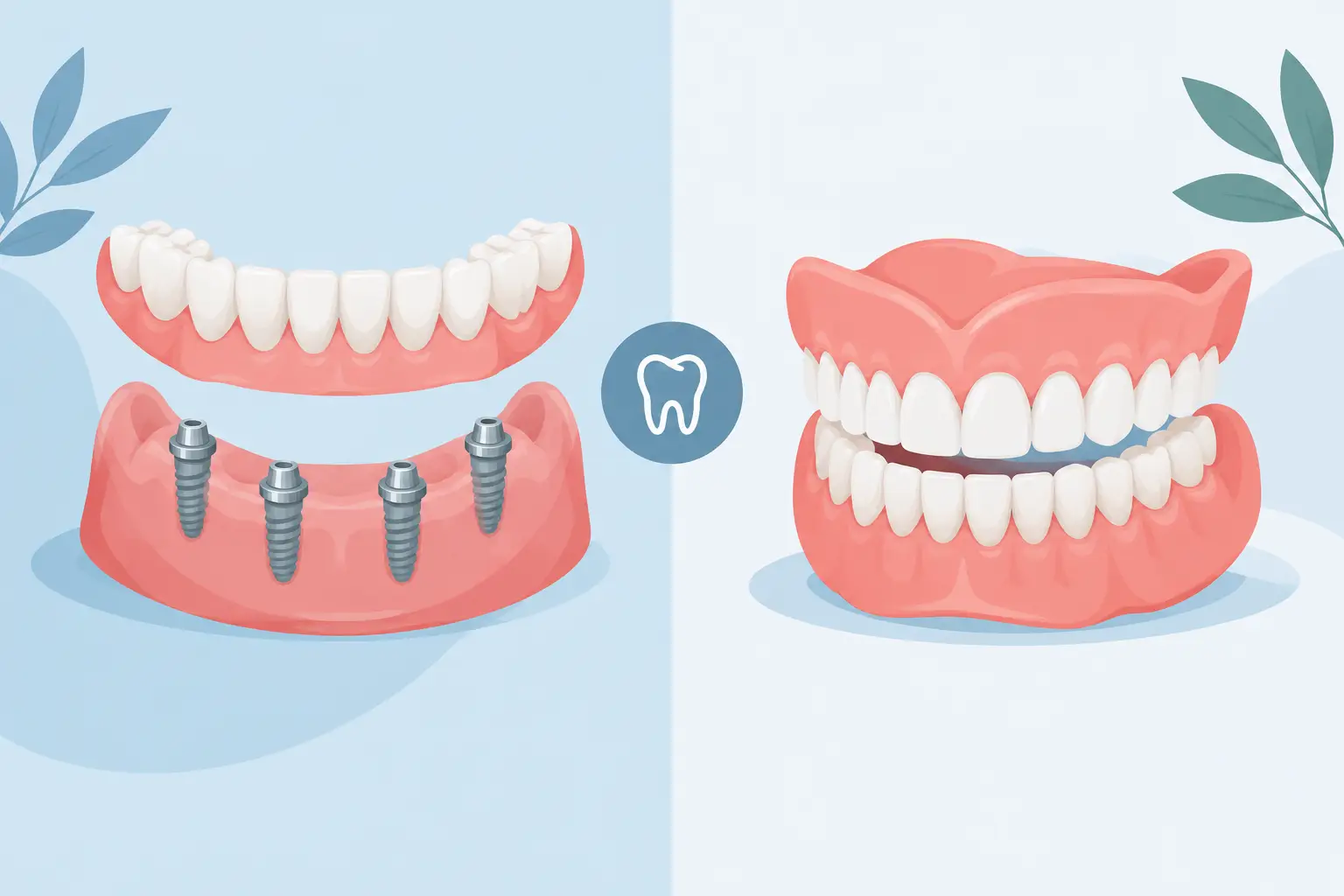
An implant-retained denture is still removed by the patient for cleaning, usually at night. It clips or attaches securely to implants using a bar, locator attachments or another precision connection. Two implants may be sufficient for a lower denture in suitable cases, while an upper denture commonly needs more support because the upper jawbone is softer and the forces of biting are distributed differently.
This option can greatly reduce the movement, rubbing and loss of confidence associated with a loose conventional denture. It also allows the roof of the mouth to be uncovered in some upper-jaw designs, which may improve taste and speech.
Because the denture is removable, access for cleaning is straightforward. It can also be a sensible route where facial support is needed, as the pink acrylic base can replace some of the gum and lip volume lost after teeth have been missing for many years.
Fixed implant bridges and All-on-X
A fixed full-arch bridge is attached to implants by the dental team and is not removed at home. Depending on the clinical plan, it may be supported by four, five or six implants. The exact number is determined by bone quality, available bone volume, bite forces and the design needed for a predictable long-term result.
Patients often choose a fixed restoration because it feels more like natural teeth. It does not need to be taken out at night, and there is no palate coverage. Many people find eating, speaking and smiling feel more intuitive once they have adapted.
A fixed solution does require committed cleaning beneath the bridge. Special brushes, floss aids and water-based cleaning devices may be recommended. The restoration must also be professionally reviewed and removed periodically when appropriate, so the implants and tissues underneath can be assessed and cleaned thoroughly.
How Fixed and Removable Options Compare
| Consideration | Implant-retained denture | Fixed implant bridge | |—|—|—| | Daily use | Removed for cleaning | Stays in place at home | | Stability | Secure, with slight removable-denture feel | Highly stable and tooth-like | | Cleaning | Usually simpler access | Requires careful cleaning under the bridge | | Palate coverage | May be present in some upper designs | No palate coverage | | Facial support | Can replace more lost gum volume | May need careful design where tissue loss is significant | | Initial investment | Often lower | Usually higher due to surgical and restorative complexity |
Neither option is automatically better. A removable overdenture can be an excellent long-term restoration when it is designed precisely and maintained well. A fixed bridge may offer greater convenience and confidence, but it should not be selected solely because it sounds more permanent or more advanced.
What Matters More Than the Number of Implants
Marketing language can make implant treatment sound formulaic: a certain number of implants, completed in a set number of days. In reality, successful full-mouth rehabilitation begins with diagnosis, not a package.
A detailed assessment considers the condition of any remaining teeth, gum health, signs of infection, jawbone volume, sinus position in the upper jaw, bite relationship and the way your lips and face are supported. Digital scans, photographs and three-dimensional imaging may be used to plan implant positions accurately and to visualise the likely final tooth shape.
This planning is particularly valuable for patients whose teeth are failing, heavily worn or affected by repeated infections. Sometimes removing all teeth and placing a full-arch restoration is the most predictable path. In other cases, preserving strategically healthy natural teeth with crowns, bridges or periodontal treatment may be better for long-term function.
At Slievemore Dental and SmileMore Implant Centre, complex cases can be planned across restorative, implant and surgical disciplines, helping ensure that the final teeth are not only attractive but also cleanable, stable and comfortable.
Bone, Gum Tissue and Aesthetics
Implants need enough healthy bone for stable placement. If teeth have been missing for a long time, the jawbone may have reduced in volume. This does not always prevent implant treatment, but it can change the plan.
Some patients benefit from bone grafting, sinus augmentation or soft tissue treatment before or alongside implant placement. Others may be suitable for angled implants that avoid certain anatomical structures and support a fixed full-arch bridge without extensive grafting. These decisions should be based on clinical evidence and imaging, rather than a one-size-fits-all promise.
Aesthetic planning matters just as much. A fixed bridge usually has less pink material than a removable denture, although this varies. If substantial gum and bone volume have been lost, the clinician must consider lip support, smile line, speech and the transition between the restoration and natural tissues. A beautiful result is not simply a row of white teeth. It should fit your face, support natural expression and function comfortably when you chew and speak.
Treatment Times and Temporary Teeth
Implant treatment may involve several stages. Where implants are placed into healthy, stable bone with good initial fixation, a provisional fixed bridge may sometimes be provided on the same day. This is often called immediate loading.
Same-day teeth are not suitable for every patient. Heavy grinding, active gum disease, poor bone quality, uncontrolled medical conditions or a complex bite may mean that a more cautious healing period is safer. A temporary denture or provisional bridge can protect the surgical sites while the implants integrate with the bone.
The final restoration is usually made after healing and refinement of the gums. This phase allows the clinical team to assess comfort, speech, bite and aesthetics before creating the definitive teeth. Taking time at this stage can make a meaningful difference to longevity and appearance.
Comfort, Anxiety and Recovery
For nervous patients, the thought of implant surgery can feel daunting. A consultation should include an open discussion about anxiety, pain control and what to expect before, during and after treatment. Implant placement is performed with careful local anaesthesia, and additional sedation options may be discussed where clinically appropriate.
Most people experience swelling, tenderness and temporary dietary limitations after surgery rather than severe pain. Soft foods are typically advised at first, particularly after full-arch treatment. Following post-operative instructions, attending reviews and avoiding smoking are important for healing.
Smoking and poorly controlled diabetes can increase the risk of complications and implant failure. A history of teeth grinding may require a protective night guard and a particularly strong restorative design. These factors do not necessarily rule out treatment, but they deserve an honest conversation before you commit.
Choosing the Option You Can Maintain
The most successful implant denture comparison ends with a practical question: which restoration can you look after confidently for years? Fixed teeth may suit someone who values a non-removable solution and is happy to use specialised cleaning aids every day. A removable implant-retained denture may suit someone who wants greater stability than a standard denture, easier cleaning access or a more manageable initial investment.
Whichever route is chosen, implants are not maintenance-free. Professional hygiene visits, home cleaning, bite checks and occasional replacement of wearing components are part of responsible long-term care. A carefully planned restoration should make these appointments straightforward, not difficult.
The best choice is the one that respects your anatomy, restores the way you want to live and gives you a realistic path to keeping your smile healthy. A thorough consultation can turn a difficult decision into a calm, clearly explained plan.