When teeth are failing, loose or already missing, the difficulty is rarely limited to appearance. Eating becomes cautious, speech can feel less certain, and the worry of another tooth breaking can affect everyday confidence. All on 4 dental implants are designed to provide a fixed full-arch solution for people who need to replace an entire upper or lower set of teeth, often without placing an implant for every missing tooth.
This is significant treatment, not a one-size-fits-all shortcut. A successful result depends on careful diagnosis, precise surgical planning, the quality of the final restoration and long-term hygiene support. For the right patient, however, it can offer a secure, natural-looking alternative to loose dentures and a renewed ability to eat, speak and smile comfortably.
What are all on 4 dental implants?
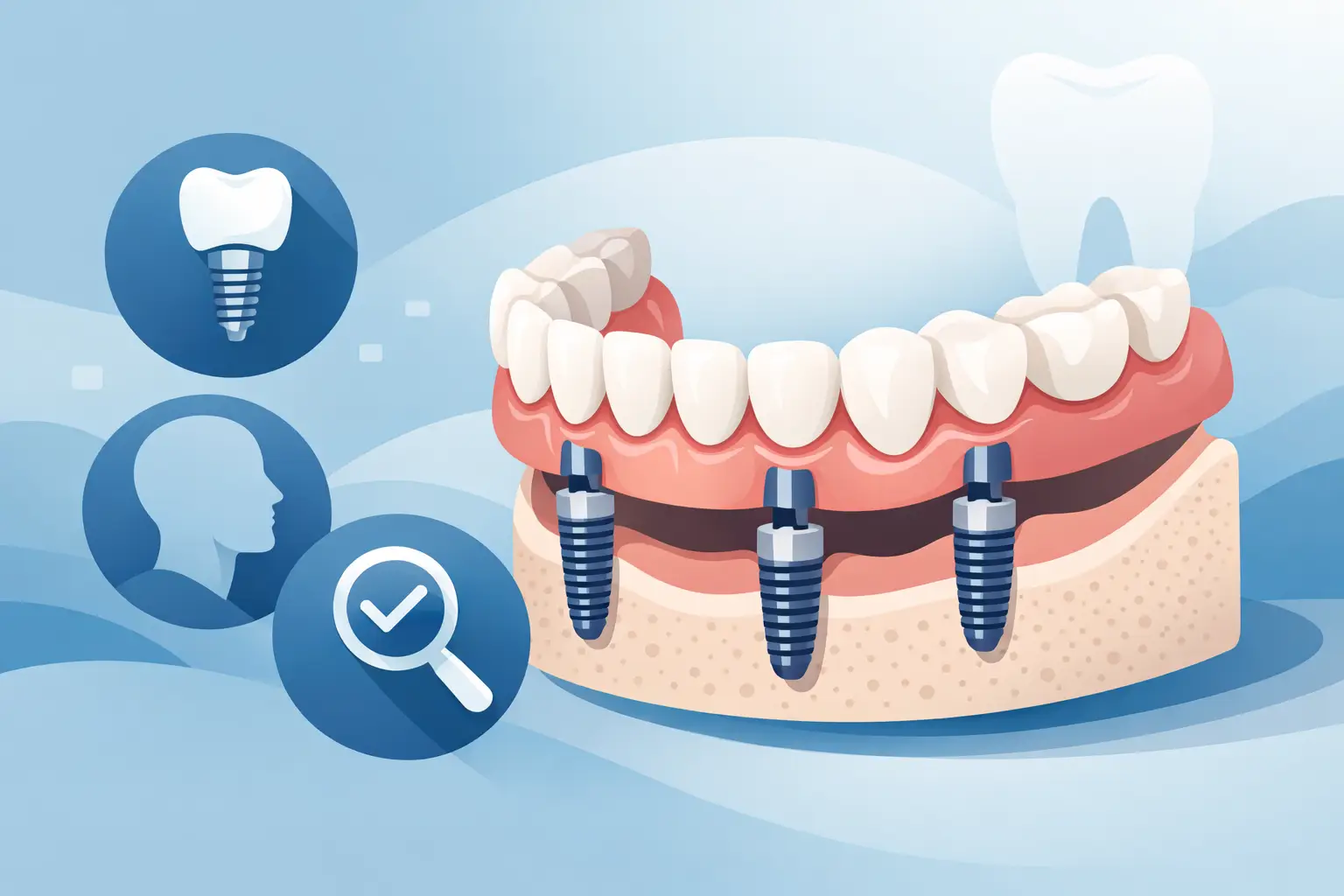
All on 4 is a full-mouth rehabilitation approach in which a complete arch of replacement teeth is supported by four carefully positioned dental implants. Two implants are generally placed towards the front of the jaw, where bone is often strongest, while the back implants may be angled to make the best use of available bone and avoid important anatomical structures.
The implants act as artificial tooth roots. Once they have integrated with the jawbone, they support a fixed bridge that replaces the visible teeth and, where needed, restores lost lip and facial support. The bridge is secured by the clinical team rather than removed by the patient each night.
The name describes a treatment concept, rather than a guarantee that four implants will suit every case. Some patients need additional implants for improved support, particularly where bone quality, bite forces or the shape of the jaw call for a different approach. This is why an individual assessment matters far more than a standard package.
Who may be suitable for All on 4 treatment?
Full-arch implant treatment can be considered by patients who have lost most or all teeth in one arch, are living with uncomfortable dentures, or have teeth affected by advanced decay, gum disease, repeated breakage or extensive old dental work. It can also be appropriate when saving individual teeth is no longer predictable or would involve a cycle of increasingly complex treatment.
Suitability is determined by much more than the number of missing teeth. Your clinician will assess the health of your gums, the volume and density of jawbone, your bite, medical history, smoking or vaping habits, and how easily you can maintain excellent oral hygiene. Conditions such as uncontrolled diabetes may affect healing, while heavy tooth grinding can place greater demands on the design and materials of the final bridge.
For nervous patients, an assessment is also a chance to discuss concerns openly. No one should feel judged for avoiding the dentist or for the current condition of their teeth. A calm, staged plan can make complex care feel more manageable.
When another option may be better
All on 4 treatment is not automatically the best answer simply because it is well known. If several natural teeth have a good long-term prognosis, a more conservative plan may preserve them. In other cases, a removable implant-retained denture, individual implants, bridges or treatment to stabilise gum disease may be more suitable.
A responsible recommendation starts with whether teeth can be saved predictably and comfortably, not with replacing everything quickly. The most appropriate treatment is the one that protects your health, function and confidence over the long term.
The planning stage is where precision begins
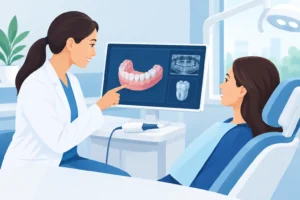
Advanced implant treatment should begin with a detailed clinical examination, photographs, digital scans and three-dimensional imaging where indicated. A CBCT scan allows the clinician to assess bone levels, sinus position, nerve pathways and other structures that must be protected during surgery.
Digital planning brings the surgical and restorative stages together before treatment begins. The position of each implant is planned around the intended teeth, bite and smile line, rather than placing implants first and trying to design the bridge around them later. This prosthetically led approach helps create a result that is functional as well as natural in proportion and appearance.
If failing teeth need to be removed, the team will also consider whether infection is present, whether bone or soft-tissue augmentation is required, and whether an immediate temporary bridge is clinically appropriate. Good planning is not about making promises before the examination. It is about reducing uncertainty and setting out a treatment path that is safe and realistic.
What happens during treatment?
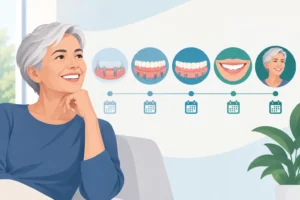
Where teeth need to be extracted, this may be carried out during the implant surgery appointment. The implants are then placed into the jaw at the pre-planned positions. Depending on the clinical situation, a temporary fixed bridge may be fitted on the same day or shortly afterwards.
Immediate teeth can be a major benefit, but they are not the final teeth and they are not suitable in every case. They are carefully designed to protect the healing implants, which means a softer diet and close adherence to instructions are essential. The priority is stable healing, not rushing to full chewing strength.
Over the following months, the implants integrate with the bone. During this phase, review appointments allow the team to monitor healing, bite and comfort. Once the implants are stable and the tissues have settled, a definitive bridge is made. This final restoration is planned for strength, cleansability, speech and a natural aesthetic that complements your face.
At SmileMore Implant Centre, full-arch care is supported by a multidisciplinary approach, bringing implant, surgical and restorative expertise into one coordinated treatment pathway. That coordination is particularly valuable when treatment involves extractions, complex bite considerations or significant rebuilding of the smile.
Recovery, comfort and adapting to your new teeth
Most patients experience some swelling, tenderness and bruising after implant surgery. These effects are usually most noticeable in the first few days and should gradually improve. Your clinician will provide tailored advice on pain relief, cleaning, food choices and when to contact the practice.
The adjustment is not only physical. Even a beautifully made fixed bridge can feel unfamiliar at first because the shape, position and bite of the teeth have changed. Speech may need a little practice, and your lips and cheeks may adapt as swelling settles. These changes are normal, but they should be monitored rather than ignored.
For the early healing period, patients are generally asked to avoid hard, crunchy or sticky foods that could overload the temporary bridge. Following these instructions is a meaningful part of treatment success. An implant can be precisely placed, but it still needs time and protection to heal properly.
Looking after a full-arch implant bridge
Implants cannot develop tooth decay, but the surrounding gums and bone can still become inflamed if plaque builds up. This condition, known as peri-implant disease, can threaten the stability of implants if left untreated.
Daily cleaning around and beneath the bridge is essential. Your dental team will show you how to use the appropriate brushes, flossing aids or water-cleaning devices for your restoration. Regular hygiene appointments and clinical reviews allow early signs of inflammation, wear or bite changes to be identified before they become more difficult to manage.
The bridge itself is durable, but it is not indestructible. Patients who grind their teeth may need a protective night guard, and all patients should avoid using their teeth to open packaging or bite very hard objects. Long-term care is a partnership between precise clinical treatment and consistent home maintenance.
Questions worth asking at your consultation
Before committing to full-arch treatment, ask what is included in the proposed plan, whether a temporary bridge is expected, how the final teeth will be made, and what maintenance will be needed afterwards. It is also sensible to ask about the alternatives, the likely treatment timeline and what happens if additional grafting or further procedures become necessary.
Cost should be transparent and considered alongside the experience of the clinical team, the diagnostic process, the materials used and ongoing support. Full-arch implant treatment is an investment in health and quality of life, so the safest choice is rarely based on price alone.
A well-planned implant bridge should never simply look like a new set of teeth. It should help you return to ordinary moments without hesitation: ordering the meal you want, speaking freely in a meeting, or smiling in a photograph without first thinking about what is missing.