A failing dentition can affect far more than your smile. It can change what you eat, how clearly you speak and whether you feel comfortable in photographs or conversations. For many patients, understanding full mouth dental implants cost is the first practical step towards making a confident, considered decision about long-term treatment.
The honest answer is that there is no single figure suitable for every patient. Full-mouth implant rehabilitation is a highly individual treatment, shaped by your oral health, bone volume, the type of restoration required and the level of planning needed to achieve a stable, natural-looking result. A proper consultation should give you clarity not only on price, but also on what your treatment includes, why each stage matters and what you can expect for the years ahead.
What does full mouth dental implants cost in Dublin?
In Dublin, full-mouth dental implant treatment commonly represents a significant investment, often ranging from approximately €25,000 to €45,000 or more for both arches. The final cost can fall outside this range where extensive preparatory treatment, complex surgery or premium restorative materials are required.
A fixed full-arch solution, sometimes described as All-on-4 or All-on-X, may cost roughly €12,000 to €22,000 per arch depending on the clinical approach and restoration provided. This is not a universal fee or a substitute for an examination. It is a useful starting point for understanding the scale of treatment.
Some patients need a full upper and lower rehabilitation. Others only require one arch, or can retain healthy teeth and replace selected missing teeth with individual implants. The most appropriate solution is not always the least expensive initial option. It is the one that protects your remaining oral health, restores comfortable function and can be maintained predictably over time.
Why the price varies so much
The implant fixtures themselves are only one part of treatment. A full-mouth result relies on careful diagnosis, surgical expertise, restorative design and ongoing support. Quoting a price without assessing your mouth, bite and medical history can leave out important stages of care.
The condition of your teeth, gums and bone
Where teeth are loose, infected or severely worn, they may need to be removed before implants can be placed. Gum disease must also be stabilised, as healthy surrounding tissues are essential for long-term implant success.
Bone naturally reduces after tooth loss, particularly when teeth have been missing for some time. If there is not enough bone to position implants safely, treatment may involve bone grafting, sinus augmentation in the upper jaw or a technique that uses a different implant position. These procedures add clinical time, materials and healing considerations, but they may be vital to creating a stable foundation.
The number and type of implants
A full arch does not necessarily mean an implant for every missing tooth. In an All-on-X treatment, a carefully planned number of implants supports a fixed bridge that replaces a complete row of teeth. The precise number, position and angle of implants depend on bone quality, facial anatomy, bite forces and the restoration being designed.
Individual implants can be an excellent choice when only a few teeth are missing or where preserving natural teeth is possible. However, replacing many teeth one by one can sometimes cost more than a full-arch solution and may involve more appointments. Your clinician should explain the trade-offs clearly rather than applying one approach to every case.
The final teeth and materials
Your provisional teeth and your final bridge may be made from different materials. A temporary fixed bridge allows you to leave the surgical phase with teeth in place while your tissues heal and your bite is assessed. The final restoration is then produced to deliver strength, natural aesthetics and a precise fit.
High-quality ceramic and zirconia restorations can offer excellent durability and lifelike appearance, particularly where smile aesthetics are important. They also require skilled laboratory work and detailed clinical adjustment. Acrylic-based bridges may have a lower initial cost and can be appropriate in certain cases, but they have different wear characteristics and may require more maintenance over time.
Digital planning and specialist care
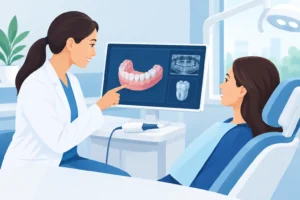
A detailed implant plan should be based on more than a standard examination. Digital scans, 3D imaging, photographs and bite records help the clinical team assess bone, nerves, gum levels and facial proportions before surgery takes place.
This digital workflow can support guided implant placement and a more predictable restorative result. It also helps your team plan where the final teeth will sit first, then position implants to support them. That restorative-led approach matters because a treatment can be technically successful yet still feel bulky, look unnatural or fail to meet your expectations if the final smile has not been considered from the outset.
What should be included in a full-mouth implant quotation?
When comparing the full mouth dental implants cost between providers, focus on what the figure actually covers. A lower headline price can be misleading if it excludes essential diagnostics, temporary teeth, sedation, extractions or the definitive bridge.
A thorough written treatment plan should make clear whether it includes consultations and scans, tooth removal where needed, implant surgery, temporary restorations, the final fixed bridge, review appointments and any planned maintenance. It should also explain potential additional costs, such as grafting, treatment of infection or replacement of a restoration in the future.
Ask which clinician is responsible for each part of your care. Full-mouth rehabilitation often benefits from coordinated input from an implant surgeon, prosthodontic or restorative clinician, hygienist and dental technician. This multidisciplinary approach can be especially valuable for complex bites, significant tooth wear or patients who have been told previously that their case is difficult.
The value of a staged, personalised plan
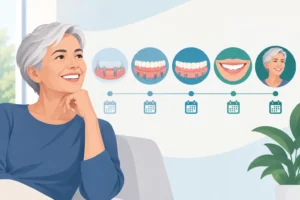
It is understandable to want a firm figure at the first conversation. Yet careful planning is not delay for its own sake. It is how your clinician determines whether immediate implants are appropriate, whether healing time is advisable and how to protect your comfort throughout treatment.
For some patients, teeth can be removed and implants placed on the same day, with a fixed provisional bridge provided shortly afterwards. For others, treating gum disease, allowing extraction sites to heal or building bone first creates a safer and more reliable outcome. Neither route is automatically better. The right sequence depends on your anatomy, health and goals.
A considered plan also addresses practical matters that are easy to overlook: how you will clean beneath the bridge, how your speech may adapt, what foods to avoid during healing and how often you should attend for professional maintenance. Implants do not decay, but the gums and bone around them still require attentive care.
Can payment plans make treatment more manageable?
Many patients prefer to spread the cost of advanced treatment rather than pay the full amount at once. Depending on the practice and your circumstances, structured payment-plan options may be available following assessment and approval. Your treatment may also be staged clinically, which can distribute costs across different phases.
The key is to base financial decisions on a complete plan rather than on a promotional price. Ask for an itemised estimate, discuss the likely timing of each payment and make sure you understand what is included in the aftercare. A good practice will approach this conversation with discretion and without judgement.
At Slievemore Dental and SmileMore Implant Centre, full-mouth cases are approached with detailed digital planning and coordinated specialist care, so patients can understand both the clinical reasoning and the investment before committing to treatment.
Choosing care for the long term
Full-mouth dental implants are not simply a cosmetic purchase. They are a functional reconstruction of your bite, smile and daily comfort. The cheapest quote may not include the diagnostic depth, materials, surgical support or long-term maintenance needed for a result that feels secure and natural.
If you are living with painful, failing or missing teeth, the most helpful next step is a calm consultation where you can ask direct questions and receive a plan built around your own mouth. Clarity about cost is valuable, but clarity about quality, safety and the life you want to return to is what makes the decision worthwhile.