A smile makeover should not begin with a catalogue of veneers. It should begin with your face, your bite, your dental health and the small details that make a smile look like it belongs to you. A digital smile design dentist uses photographs, scans and clinical planning to show how proposed changes may work before treatment starts – but the quality of the result depends on the judgement behind the technology.
For patients considering cosmetic dentistry in Dublin, digital smile design can bring welcome clarity. It makes conversations more precise, helps patients visualise options and allows the clinical team to plan restorations with greater control. It is not, however, a shortcut to a healthy, natural-looking smile. The best outcomes come from careful diagnosis and treatment that protects function as well as appearance.
What digital smile design actually involves
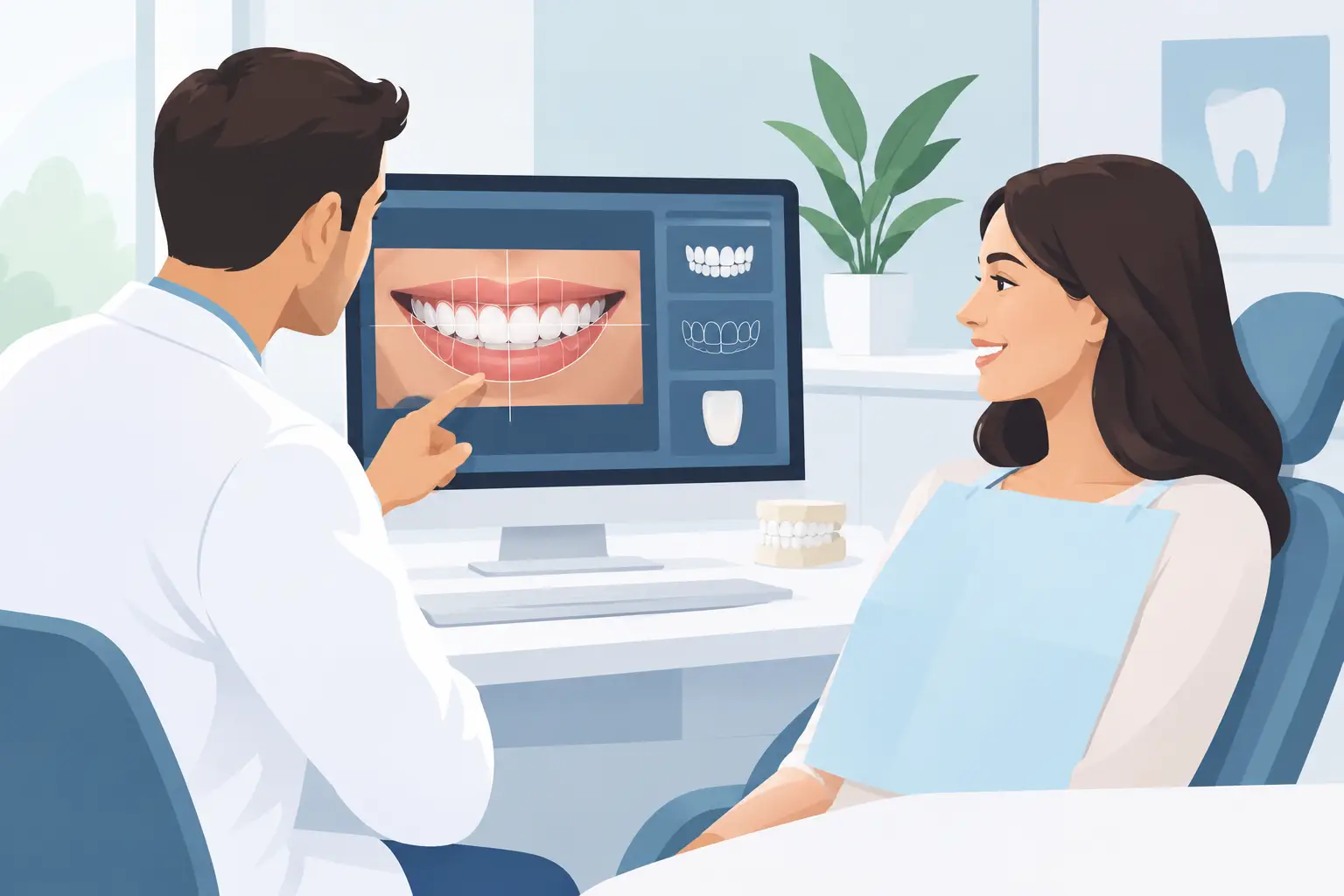
Digital Smile Design, often shortened to DSD, is a planning approach that combines high-quality photographs, video, digital impressions or intraoral scans, X-rays and facial measurements. These records allow the dentist to assess how your teeth relate to your lips, facial proportions, gum line and bite.
Rather than deciding on tooth shape or shade in isolation, the dentist can create a proposed smile design on screen. This may be used to plan composite bonding, porcelain veneers, crowns, orthodontic treatment, gum contouring, implants or a combination of treatments. In more complex cases, it can form part of a wider restorative plan involving several clinicians.
The digital design is a communication and planning tool, not the final treatment itself. It can help you understand what is being considered, but it must always be tested against the realities of your mouth: enamel quality, gum health, tooth position, jaw function and the forces placed on your teeth every day.
Why the dentist matters as much as the software
Software can draw symmetrical teeth on a photograph. It cannot independently diagnose gum disease, identify a failing tooth, assess clenching, or decide whether a proposed veneer design will be kind to your bite. This is why choosing a digital smile design dentist means looking beyond before-and-after images.
A clinically led plan considers whether your teeth are stable enough for cosmetic work. If there is active decay, gum inflammation, tooth wear, cracks, old restorations or an unstable bite, these concerns should be addressed first or incorporated into the treatment sequence. Ignoring them may produce a pleasing early result that becomes difficult to maintain.
Natural aesthetics also require restraint. Very white, very uniform teeth may suit some patients, but they are not automatically the most flattering or believable choice. Small variations in surface texture, translucency, tooth length and shade are often what stop a restored smile from looking artificial. A skilled dentist will discuss what you like about your existing smile as well as what you would like to change.
At Slievemore Dental, digitally planned aesthetic care is supported by a multidisciplinary approach, allowing cosmetic decisions to be coordinated with restorative, orthodontic, periodontal and implant considerations where needed.
The consultation: from concerns to a clear plan
A considered smile design consultation starts with listening. You may be concerned about worn edges, uneven teeth, gaps, old crowns, staining, a gummy smile or teeth that look short in photographs. Your dentist should ask how these concerns affect you, whether you have noticed changes over time and what you want your smile to feel like, not simply how you want it to look.
Clinical assessment follows. This may include an examination of the teeth and gums, bite analysis, photographs, digital scans and appropriate radiographs. For patients with significant wear, missing teeth or discomfort in the jaw muscles, the evaluation may need to be more detailed. A smile is not static, and neither is the way you use it.
Once the records are gathered, the dentist can talk you through suitable options. In some cases, whitening and small areas of composite bonding are enough. In others, orthodontics may create the space and alignment needed to reduce the amount of drilling required for veneers or crowns. If teeth are badly broken down, heavily restored or missing, a more comprehensive rehabilitation may be the safer and more predictable route.
Seeing a preview is useful, but it is not a promise
A digital preview can be reassuring, particularly if you find it hard to imagine a change to your smile. Depending on the case, your dentist may also offer a temporary mock-up, placed over your teeth so you can see the proposed shapes directly in the mouth. This can help assess speech, lip support and your reaction to the appearance.
Still, a preview has limits. Lighting, lip position, camera angle and screen settings all affect how a design appears. Final ceramic restorations also have optical qualities that cannot be fully reproduced in a flat image. Think of the design as an informed direction and a shared reference, rather than an exact guarantee of every detail.
Which treatments can form part of a digital smile design?
The right treatment is determined by the condition of your teeth and your goals. Digital planning may support whitening before restorations are matched to a brighter shade, or minimally invasive composite bonding where small adjustments can improve balance and proportion.
Porcelain veneers can be effective when teeth need more significant changes in shape, colour or surface quality. Yet veneers are not always the conservative choice. Some teeth require preparation, and they need thoughtful maintenance over the years. If healthy, well-positioned teeth can be improved with whitening, bonding or orthodontics, those options deserve proper discussion.
Crowns may be more appropriate for teeth that are extensively damaged or have large existing fillings. For patients with missing teeth, implant-supported crowns or bridges can be planned digitally to restore both appearance and function. When several teeth have worn down or failed, full-mouth rehabilitation may be needed to rebuild the bite in a controlled way.
Gum shape matters, too. A tooth can appear short because of its proportions, its position or excess gum display. Any gum treatment should be planned cautiously, with respect for the underlying bone, tissue health and long-term stability. Cosmetic dentistry is at its best when it works with biology, rather than trying to overpower it.
Questions worth asking before you proceed
A good consultation should leave you informed, not pressured. Ask what is causing the issue you wish to change, what alternatives are available and how much natural tooth structure each option is likely to preserve. It is also sensible to ask how the proposed treatment affects your bite and what maintenance will be required.
You should understand the likely lifespan of the restorations, while recognising that no dentist can predict precisely how long any restoration will last. Home care, regular hygiene visits, diet, grinding habits and accidental damage all make a difference. A night guard may be recommended if you clench or grind your teeth, especially after veneers, crowns or extensive restorative work.
Cost should be discussed transparently as part of the plan, rather than as an afterthought. Phased care can sometimes be appropriate, but only when each stage protects the overall result. The least expensive option today is not always the best value if it creates avoidable retreatment later.
A calmer route for nervous patients
If you have avoided the dentist because of anxiety, a digitally planned smile makeover may sound overwhelming. It should not feel that way. The planning stage can be broken into manageable appointments, with time to ask questions and consider your choices. You remain in control of the pace.
For many nervous patients, simply being able to see and discuss a proposed outcome reduces uncertainty. Equally valuable is knowing that treatment will not be rushed. Gentle care, clear explanations and a judgement-free approach are not extras in aesthetic dentistry – they are central to making sound decisions.
A well-designed smile should look at home on your face, feel comfortable when you speak and eat, and be built on teeth and gums that can support it for the long term. Choose the clinician who gives that foundation as much attention as the final photograph.