A tooth that has failed, fractured or become painful can make speed feel like the only priority. Yet when considering same day versus delayed implants, the best option is not automatically the fastest one. It is the approach that gives the implant the strongest possible foundation, protects your appearance and supports comfortable, long-lasting function.
For some patients, an implant can be placed immediately after a tooth is removed, often with a temporary tooth fitted during the same visit. For others, allowing the area to heal before implant placement is the safer and more predictable choice. Both are established treatment pathways. The difference lies in the condition of the bone, gums, bite and surrounding teeth.
What do same-day and delayed implants mean?
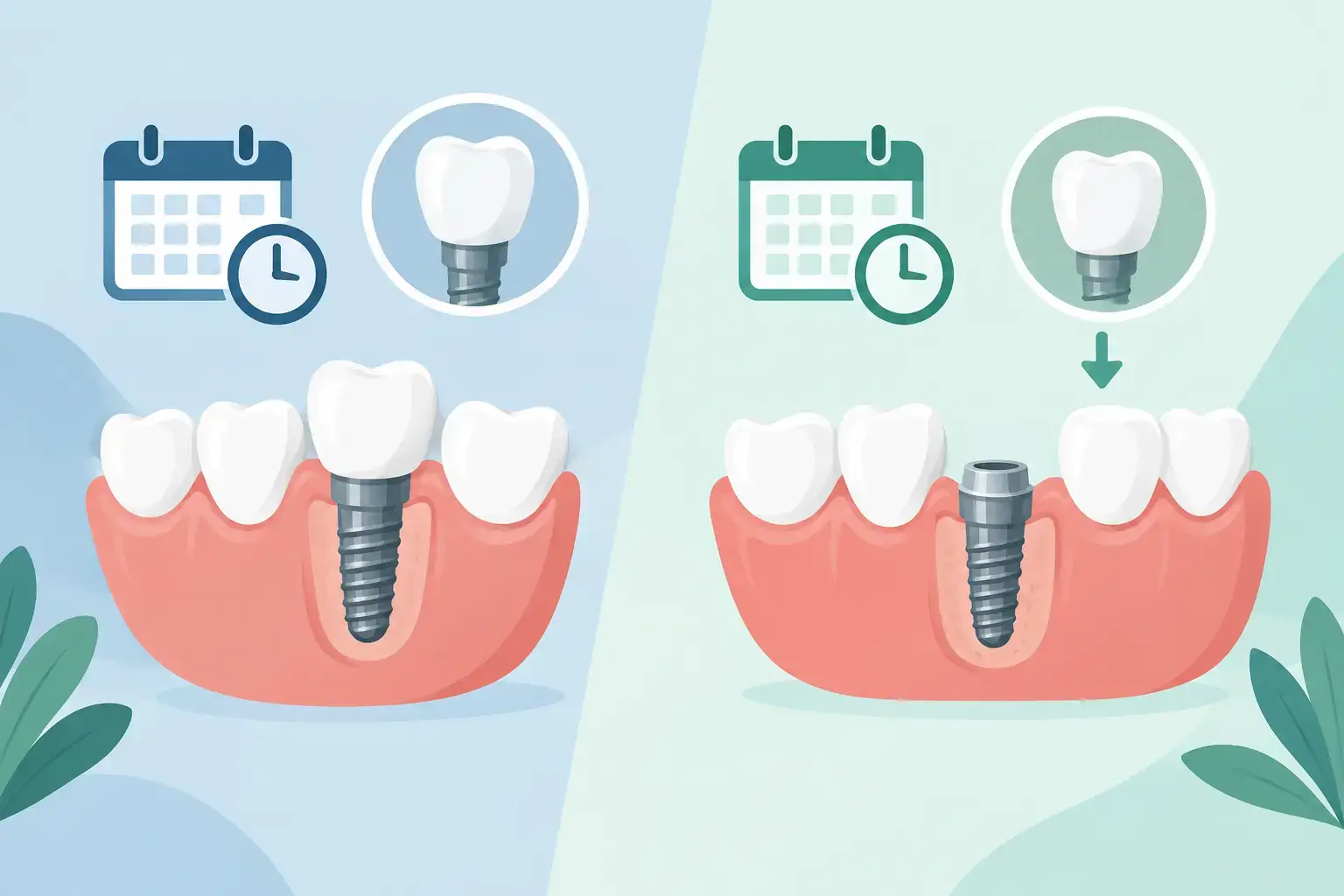
A same-day implant, also called immediate implant placement, is inserted into the tooth socket at the same appointment as the extraction. Where the implant is stable enough and the case is suitable, a provisional crown or bridge may be fitted straight away. This temporary restoration is designed to protect the site and support your smile while healing takes place.
A delayed implant is placed after a period of healing. This may be several weeks after extraction, or several months where infection, bone loss or grafting needs more time to resolve. The final crown is not rushed. It is planned once the implant has integrated securely with the jawbone and the gums have matured around it.
One point is worth clarifying: immediate placement and immediate loading are not the same thing. An implant may be placed on the day of extraction without receiving a tooth straight away. Equally, a temporary tooth fitted on the same day is not a final crown. The final restoration is made later, once healing and bite stability can be properly assessed.
When same-day implant placement may be appropriate
Same-day treatment can be an excellent option when a tooth must be removed but the surrounding structures are healthy and stable. It may reduce the number of surgical appointments and can help preserve the natural contour of the gum and bone, particularly in the visible front of the mouth.
The ideal case usually has enough healthy bone to secure the implant firmly at the time of surgery. The gum tissue should be in good condition, there should be no uncontrolled infection, and your bite must allow a temporary tooth to stay protected from excessive pressure. Patients also need to be able to follow careful aftercare instructions during the early healing phase.
For a front tooth, the aesthetic benefit can be significant. Removing the damaged tooth, placing an implant precisely and providing a carefully shaped temporary tooth can help maintain confidence during treatment. However, this does not make it a shortcut. Immediate treatment requires detailed planning, exact implant positioning and close control of the bite. A temporary crown that looks natural but is overloaded by chewing can compromise healing.
Same-day implants are often less suitable where there is active infection with significant tissue destruction, a thin or damaged gum profile, insufficient bone to achieve stability, or a history of heavy clenching and grinding. Smoking, poorly controlled diabetes and certain medical conditions can also affect healing. These factors do not always rule out implants, but they may change the timing and preparation required.
Why delaying an implant can protect the final result
Delayed placement is sometimes presented as the slower alternative, but it is often the more considered route. If infection is present around a failing tooth, extraction gives the body time to heal and allows the clinician to confirm that the site is clean and healthy before implant surgery.
Healing also creates an opportunity to rebuild what has been lost. Bone grafting may be recommended where the jaw has resorbed after tooth loss, or where infection has damaged the socket walls. Soft tissue augmentation may be used to improve the thickness and shape of the gum around a future implant. These steps can be especially valuable in the smile zone, where stable, natural-looking gum contours are as important as the crown itself.
A delayed approach can also make complex treatment more predictable. If several teeth are failing, if the bite has collapsed, or if there are signs of periodontal disease, the priority may be to stabilise the wider mouth first. This can include gum treatment, temporary restorations, bite planning or treatment of neighbouring teeth before implant surgery is undertaken.
Waiting is not doing nothing. It is an active stage of treatment intended to create the conditions for an implant restoration that feels comfortable, looks harmonious and is easier to maintain over time.
Choosing between same day versus delayed implants
The decision starts with diagnosis, not a calendar. A thorough consultation should include a review of your medical and dental history, examination of the teeth and gums, bite assessment and three-dimensional imaging where indicated. Digital scans and cone beam CT imaging allow the clinical team to assess bone volume, identify vital structures and plan implant position with precision.
Several details carry real weight. The clinician will look at the reason the tooth is being lost, whether infection is contained, the thickness of the facial bone, the quality of the gum tissue and how much primary stability can be achieved when the implant is inserted. Your smile line matters too. If a high smile reveals a large amount of gum, even small changes in tissue contour can affect the aesthetic result.
Your lifestyle and expectations matter as well. A patient seeking a discreet temporary solution for a visible front tooth may be a candidate for immediate placement, but only if the biology supports it. Someone who grinds their teeth at night may benefit from a more cautious programme and a protective night guard after restoration. The treatment plan should be tailored, rather than built around a promise of same-day treatment.
The role of digital planning and temporary teeth
Modern implant dentistry is planned backwards from the intended final smile. Rather than placing an implant wherever bone is available, the clinician considers where the final crown needs to sit for a natural appearance, a healthy gum line and an even bite. Digital scans, photographs and imaging support this restorative-led approach.
Where appropriate, guided surgery can help transfer the digital plan accurately to the clinical setting. A provisional crown or bridge can then be shaped to support the gum tissues without placing damaging pressure on the healing implant. This is particularly relevant for immediate implants in prominent areas of the mouth.
At Slievemore Dental, complex implant cases can be coordinated across restorative, implant and surgical expertise. That multidisciplinary perspective is valuable when treatment involves bone grafting, multiple missing teeth, a compromised bite or a full-mouth rehabilitation rather than a single straightforward replacement.
What healing and aftercare involve
Whether an implant is placed immediately or after a healing period, osseointegration takes time. This is the process in which living bone bonds to the implant surface. It is why early care matters so much.
You may be asked to eat a softer diet, avoid biting directly on a temporary tooth and maintain meticulous oral hygiene around the site. Some swelling and tenderness are normal after surgery, but severe pain, increasing swelling, persistent bleeding or a loose temporary restoration should be reviewed promptly. Smoking can significantly increase the risk of poor healing and implant complications, so stopping or reducing it is strongly advised.
Once the implant has integrated, the final crown, bridge or full-arch restoration is made. It should be designed not only for colour and shape, but also for cleanability, bite balance and support of the surrounding gums. Regular hygiene appointments and reviews are central to protecting the investment you have made.
A well-timed implant is the one that lasts
Same-day treatment can be life-changing for the right patient, particularly when a visible tooth cannot be saved. Delayed treatment can be equally valuable when it gives damaged bone and gums the time they need to recover. Neither route is inherently better.
The reassuring question to ask is not, “Can this be done today?” but, “What gives me the safest and most natural result for the years ahead?” A careful clinical assessment can provide an answer that protects both your confidence now and your oral health long after treatment is complete.