A loose denture that shifts while you speak, avoiding a meal you once enjoyed, or repeatedly repairing failing teeth can make everyday life feel unnecessarily restricted. An All-on-X treatment review should look beyond the promise of a fixed new smile. It should establish whether the treatment is safe for you, what can realistically be achieved, and what commitment is needed to protect the result over time.
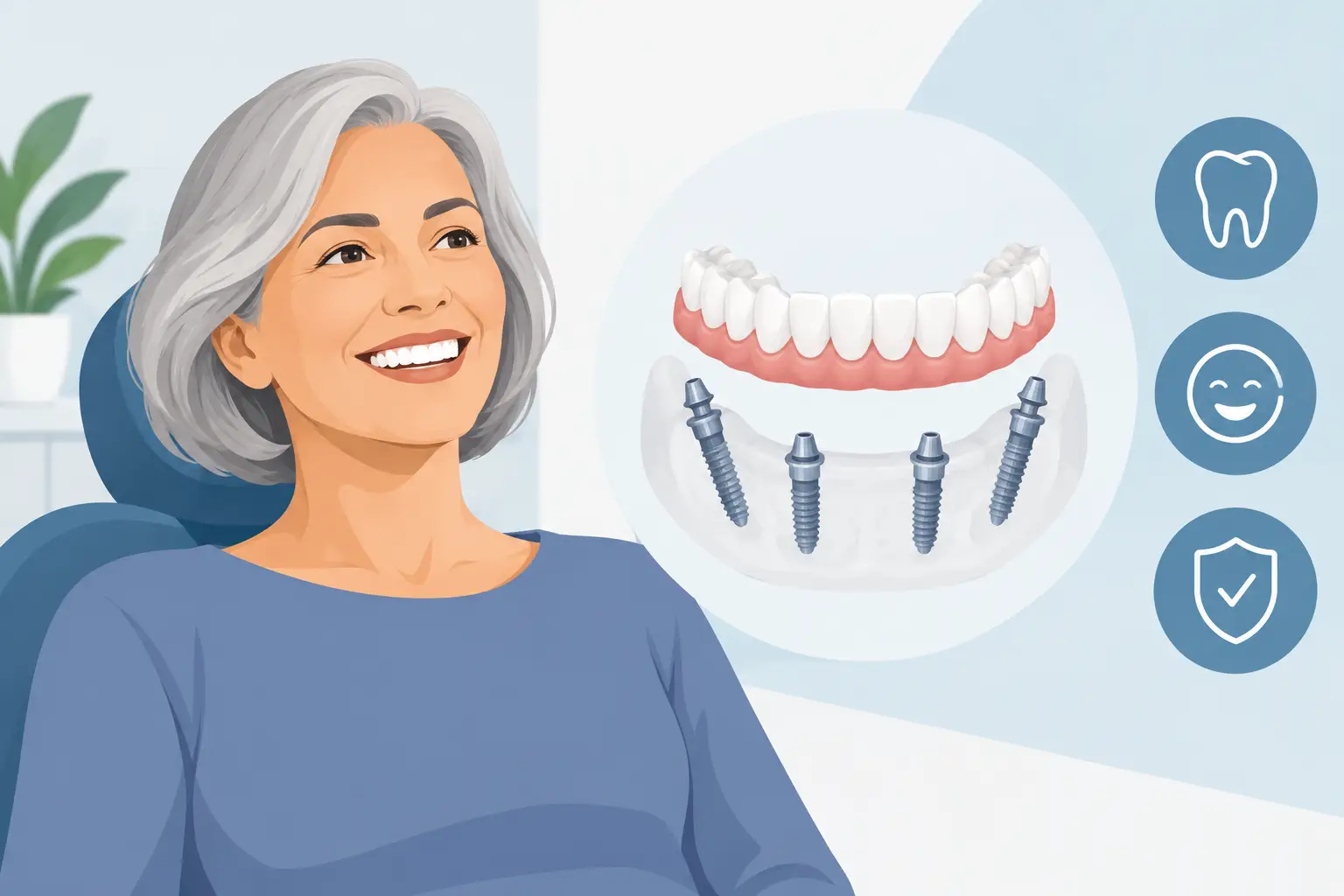
All-on-X is a full-arch implant treatment for people who have lost most or all teeth in an upper or lower jaw, or whose remaining teeth have a poor long-term outlook. A carefully planned bridge is secured to a small number of dental implants – often four, but sometimes more where anatomy or bite forces require it. The result is fixed in place rather than removable by the patient, restoring the appearance, stability and function of a complete arch of teeth.
What a thorough All-on-X treatment review should cover
The phrase All-on-X refers to a treatment concept, not one identical procedure for every patient. The number, angle and position of implants, the design of the final bridge, whether teeth are removed, and the timing of the final restoration all depend on detailed clinical findings.
A responsible assessment begins with your health history, current medication and dental history. Conditions such as uncontrolled diabetes, active gum disease, heavy smoking, teeth grinding and certain bone-health medicines do not automatically rule out implant treatment, but they can affect healing, risk and planning. These conversations should be direct and judgement-free. Good outcomes start with an honest understanding of the factors that can be managed and those that may change the recommendation.
Your clinician should then assess the teeth, gums, bite, jaw joints and available bone. Digital scans and three-dimensional imaging allow the surgical team to examine vital structures, including nerves and sinus spaces, before proposing implant positions. This digital workflow also helps plan the final tooth position first, so the surgery supports both function and natural-looking facial aesthetics.
For many people, the most valuable part of the review is hearing whether their own teeth can be retained. All-on-X can be life-changing when teeth are severely damaged, mobile, painful or repeatedly failing. It is not automatically the best route simply because several teeth are missing. In some cases, staged treatment, individual implants, crowns, periodontal care or a removable option may preserve healthy teeth and offer a more appropriate long-term solution.
The temporary smile and the final bridge are different stages
Patients often see impressive photographs of immediate fixed teeth and assume the treatment is completed in a day. It is possible to provide a fixed provisional bridge on the day of surgery in suitable cases. This can spare a patient from wearing a removable denture during early healing and can be a significant confidence boost.
However, the initial bridge is usually a carefully designed temporary restoration. Implants need time to integrate with the bone, while swelling settles and the gums mature. Your bite, speech, comfort and appearance are reviewed during this period. The final bridge is made only when the tissues and implants are stable enough to support a more definitive restoration.
That distinction matters. A good final result is not only about white, even teeth. It must allow clear speech, cleanable contours, appropriate lip support and a bite that distributes forces sensibly. Where possible, the shape, shade and tooth display should be discussed in advance, rather than decided at the final fitting.
Benefits that make All-on-X worth considering
For the right candidate, a fixed full-arch restoration can replace the uncertainty of failing teeth or loose dentures with a more secure, dependable solution. Because the bridge is supported by implants, it does not cover the roof of the mouth in the way an upper denture often does. This can improve comfort and may make food feel more enjoyable.
The treatment can also simplify a complex dental situation. Instead of attempting to repair each compromised tooth separately, a full-arch plan can address infection, tooth loss, poor function and worn dentition as one coordinated rehabilitation. Patients frequently value being able to smile, speak and attend social occasions without worrying that teeth or dentures will move.
There are practical advantages too. Strategic placement of implants can sometimes avoid the need to replace every missing tooth with an individual implant. Yet “fewer implants” should never be interpreted as “minimal planning”. Implant number is selected to suit bone volume, arch shape, opposing teeth, bite forces and the design of the proposed bridge.
The trade-offs deserve equal attention
All-on-X is advanced treatment involving surgery, a healing period and lifelong maintenance. If remaining teeth are being removed, that decision is irreversible. It should be made because their prognosis is poor, not because extraction appears quicker than careful diagnosis.
As with any surgery, there are risks. These may include swelling, bruising, discomfort, infection, delayed healing, temporary changes in sensation and, less commonly, implant failure. Upper-jaw treatment can involve sinus considerations; lower-jaw treatment requires careful attention to the position of nerves. Digital planning and experienced surgical care reduce avoidable risk, but no ethical clinician should present implant surgery as risk-free.
The final bridge also needs looking after. Food and plaque can accumulate beneath it, so cleaning tools and technique are part of treatment, not an optional extra. Professional hygiene visits and regular implant reviews help monitor gum health, bite changes and the condition of the restoration. Components may need maintenance over the years, particularly for patients who clench or grind their teeth.
Cost should be discussed in terms of the entire treatment pathway. A meaningful estimate accounts for diagnostics, extractions where needed, grafting or soft-tissue treatment if indicated, surgery, provisional teeth, the final bridge and follow-up care. A lower initial figure may not represent the same materials, planning, clinical time or aftercare. Asking what is included protects against unwelcome surprises and makes comparisons more useful.
What recovery usually involves
Recovery is individual, particularly where multiple teeth are removed or grafting is required. Most patients experience swelling and tenderness in the first few days, with gradual improvement over the following week or two. Pain relief, dietary advice and clear post-operative instructions should be tailored to your procedure and medical history.
A soft diet is normally necessary while implants heal, even if you have fixed temporary teeth. This is not a sign that treatment has gone wrong. It protects the implants from excessive force at a stage when they are integrating with bone. Smoking can significantly compromise healing, so a clinician may advise stopping well before surgery and throughout recovery.
It is sensible to plan a little quiet time after treatment rather than booking surgery immediately before a major presentation, wedding or holiday. Contact the practice promptly if pain is worsening rather than easing, swelling becomes severe, you develop a fever, or a temporary bridge feels loose or changes suddenly in your bite.
Questions to ask before you proceed
A consultation should leave you better informed, not rushed. Ask whether your natural teeth can be predictably retained, why the proposed number of implants is appropriate, and whether you are suitable for immediate fixed teeth. Ask who will carry out the surgical and restorative stages, what happens if grafting is required, and how the plan will be adjusted if healing differs from expectations.
It is equally reasonable to ask about the provisional bridge, final bridge material, expected maintenance and the likely lifespan of components. Look for answers that are specific to your mouth rather than a standard sales pitch. A multidisciplinary team can be particularly valuable where gum health, complex bite issues, bone loss or facial aesthetic concerns need to be considered together.
At Slievemore Dental and SmileMore Implant Centre, full-arch cases are planned with a specialist-led, digitally guided approach, with attention to surgery, function, gum health and the appearance of the final smile. For nervous patients, the pace of care and clear explanations can be just as important as the technology involved.
The right decision is not necessarily the quickest route to new teeth. It is the plan that protects your health, gives you a realistic view of recovery and delivers a smile you can care for comfortably for many years.