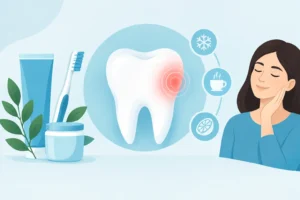
A tooth can crack while biting on a hard sweet, chewing a crusty roll or clenching during a stressful night. The discomfort may be fleeting, which leads many people to ask: can a cracked tooth heal? The short answer is no. Unlike bone, tooth enamel and dentine cannot knit back together after a fracture. Yet a crack does not automatically mean tooth loss. Prompt, precise care can often protect the tooth, stop the crack progressing and restore comfortable function.
Can a cracked tooth heal on its own?
A cracked tooth cannot heal in the biological sense. Enamel is the hard protective outer layer of the tooth, but it contains no living cells that can regenerate after it fractures. Beneath it lies dentine, which is more flexible and can form some protective tissue in response to irritation. This may reduce sensitivity in limited circumstances, but it does not seal or repair the crack itself.
That distinction matters. A small line on a tooth may remain stable for years, while a deeper crack can open slightly each time you bite. Chewing forces may drive bacteria towards the nerve inside the tooth or extend the fracture below the gum line. The aim of treatment is therefore to assess the depth and direction of the crack, then hold and protect the tooth before more serious damage occurs.
It is also worth knowing that a tooth may feel better for a period even though the crack remains. Reduced pain is reassuring, but it is not proof that the problem has resolved.
Not every line in a tooth is the same
Fine surface lines, often called craze lines, are common in adult teeth. They are usually limited to enamel and may be noticed as faint vertical marks, particularly on front teeth. They generally do not cause pain or compromise the strength of the tooth. If their appearance is a concern, a clinician can discuss conservative cosmetic options.
A fractured cusp is different. This is when a piece of the biting surface breaks, often around a large older filling. It may feel sharp or cause sensitivity, but the tooth’s nerve is not always affected. A bonded restoration, onlay or crown can frequently rebuild and reinforce the area.
A crack extending from the chewing surface towards the root needs more careful assessment. People often describe sharp pain when releasing a bite rather than when pressing down. Sensitivity to cold, heat or sweet foods can also occur. If the crack reaches the pulp, root canal treatment may be needed before the tooth is protected with a crown or another suitable restoration.
The most difficult situation is a split tooth or a vertical root fracture. When a fracture runs deeply through the root, keeping the entire tooth may not be predictable. In some cases, part of a multi-rooted tooth can be treated; in others, extraction and a carefully planned replacement may be the healthiest long-term option.
Signs you should arrange an urgent dental assessment
A visible break is not the only sign of a cracked tooth. Cracks can be difficult to see, including on standard X-rays, because they may be extremely narrow. Your symptoms, bite pattern and clinical examination are often just as valuable in reaching a diagnosis.
Arrange an urgent appointment if you have pain on biting, a sharp twinge when you release your bite, new temperature sensitivity, swelling around a tooth, or a tooth that feels rough, loose or changed in shape. A persistent dull ache can also signal inflammation inside the tooth.
Seek same-day dental advice if facial swelling is developing, pain is severe or you have a cracked tooth following an injury. Swelling, fever, difficulty swallowing or breathing require urgent medical attention. Dental infections should never be left to settle without professional assessment.
Think you’ve cracked a tooth? Our emergency dentist in Stillorgan can check it the same day, 7 days a week. Call +353 1 283 1000.
What to do while you wait to be seen
Until your appointment, avoid chewing on the affected side and choose softer foods. Do not test the tooth repeatedly by biting down to see whether it still hurts. That can worsen a fracture that may otherwise have been manageable.
Keep the area clean with gentle brushing and flossing, unless floss catches in a broken edge. Rinse with warm water after meals. If a sharp edge is irritating your tongue or cheek, temporary dental wax from a pharmacy may provide short-term comfort. Over-the-counter pain relief may be appropriate when taken exactly as directed on the packet, provided it is safe for you to use.
Avoid placing household glue, filling material not designed for dental use, or aspirin directly on the gum. These can damage soft tissues and make definitive treatment more difficult. If a piece of tooth has come away, bring it to the appointment if possible, although it cannot always be reattached.
How dentists protect a cracked tooth
Treatment depends on the crack’s location, depth, the condition of the nerve and the amount of healthy tooth remaining. A meticulous examination may include magnification, bite testing, photographs, digital X-rays and removal of an old restoration where necessary to inspect the tooth properly. In complex cases, three-dimensional imaging can help clarify the anatomy and support confident planning.
For a minor chip or shallow fracture, composite bonding may smooth the edge and restore the tooth’s natural contour. Where more support is needed, a ceramic onlay covers vulnerable biting surfaces while preserving more natural tooth structure than a full crown in suitable cases.
A crown is often recommended when a tooth has a significant crack, a large failing filling or weakened cusps. It works like a protective shell, distributing bite forces and reducing the risk of the crack spreading. Modern digital workflows allow restorations to be planned with close attention to bite, fit and natural aesthetics.
If the nerve has become irreversibly inflamed or infected, root canal treatment removes the damaged tissue inside the tooth. The tooth is then restored to protect it from further fracture. Root canal treatment does not make a tooth “dead” in the sense of useless – with appropriate restoration and ongoing care, it can continue to function for many years.
Where a tooth cannot be predictably saved, extraction may be the most responsible recommendation. This is never a decision made lightly. Replacement options can include a dental implant, bridge or removable solution, selected according to your gum health, bite, neighbouring teeth, overall health and goals for appearance and function.
Why early treatment can make a real difference
The trade-off with a cracked tooth is straightforward: waiting may avoid an appointment today, but it can reduce the range of conservative options tomorrow. A tooth that could have been stabilised with an onlay may later require root canal treatment and a crown. If a crack progresses into the root, restoration may no longer be possible.
Early treatment is particularly valuable for people who grind or clench their teeth. Night-time grinding can place substantial pressure on back teeth, crowns and fillings. Once the tooth is stable, a custom night guard may help protect it and other vulnerable teeth from further loading. Bite assessment is important too, as an uneven contact can concentrate force repeatedly on one area.
Can you prevent another crack?
Not every crack is preventable. Teeth naturally experience years of chewing forces, temperature changes and wear. However, regular examinations allow early signs of weakened enamel, large failing fillings, tooth wear and bite imbalance to be identified before a fracture occurs.
Avoid chewing ice, pen lids or hard objects, and use scissors rather than your teeth to open packaging. If you play contact sport, a professionally fitted mouthguard offers far better protection than a thin shop-bought version. For patients with extensive wear, old restorations or multiple cracks, a more comprehensive plan may be appropriate to restore strength and balance across the bite.
At Slievemore Dental, cracked teeth are assessed with the same focus on comfort, precision and long-term predictability as any other restorative concern. If you are nervous about treatment, tell the team from the outset. A calm explanation of what is happening, what can be done and what you may feel can make an urgent dental visit far more manageable.
A cracked tooth will not fuse back together, but acting early gives it the best chance of remaining a comfortable, functional part of your smile. If biting feels different or a tooth has begun to complain, treat that change as useful information rather than something to endure.