A missing tooth can change far more than a photograph. You may start chewing on one side, avoid certain foods, speak less freely, or become conscious of a gap whenever you smile. This guide to replacing missing teeth explains the main treatment choices, what makes one option more suitable than another, and why a detailed assessment matters before any decision is made.
Replacement is not purely cosmetic. Teeth work as a system: each one supports your bite, neighbouring teeth and facial appearance. When a tooth is lost, surrounding teeth can gradually drift into the space, the opposing tooth may over-erupt, and the jawbone in that area can reduce over time. Acting promptly is often helpful, but the right treatment should never be rushed.
Why replace a missing tooth?
For a front tooth, confidence and natural appearance are understandably high priorities. For a back tooth, restoring comfortable chewing and protecting the bite may be the main concern. In either position, replacing a missing tooth can help distribute biting forces more evenly and prevent changes that make future treatment more complex.
That said, not every space requires replacement. A missing wisdom tooth, for example, rarely needs one. Some people also adapt well to a short gap at the very back of the mouth. A clinician will consider your chewing function, bite stability, gum health, remaining teeth, aesthetic goals and long-term maintenance needs rather than recommending the same solution for everyone.
Your guide to replacing missing teeth: the main options
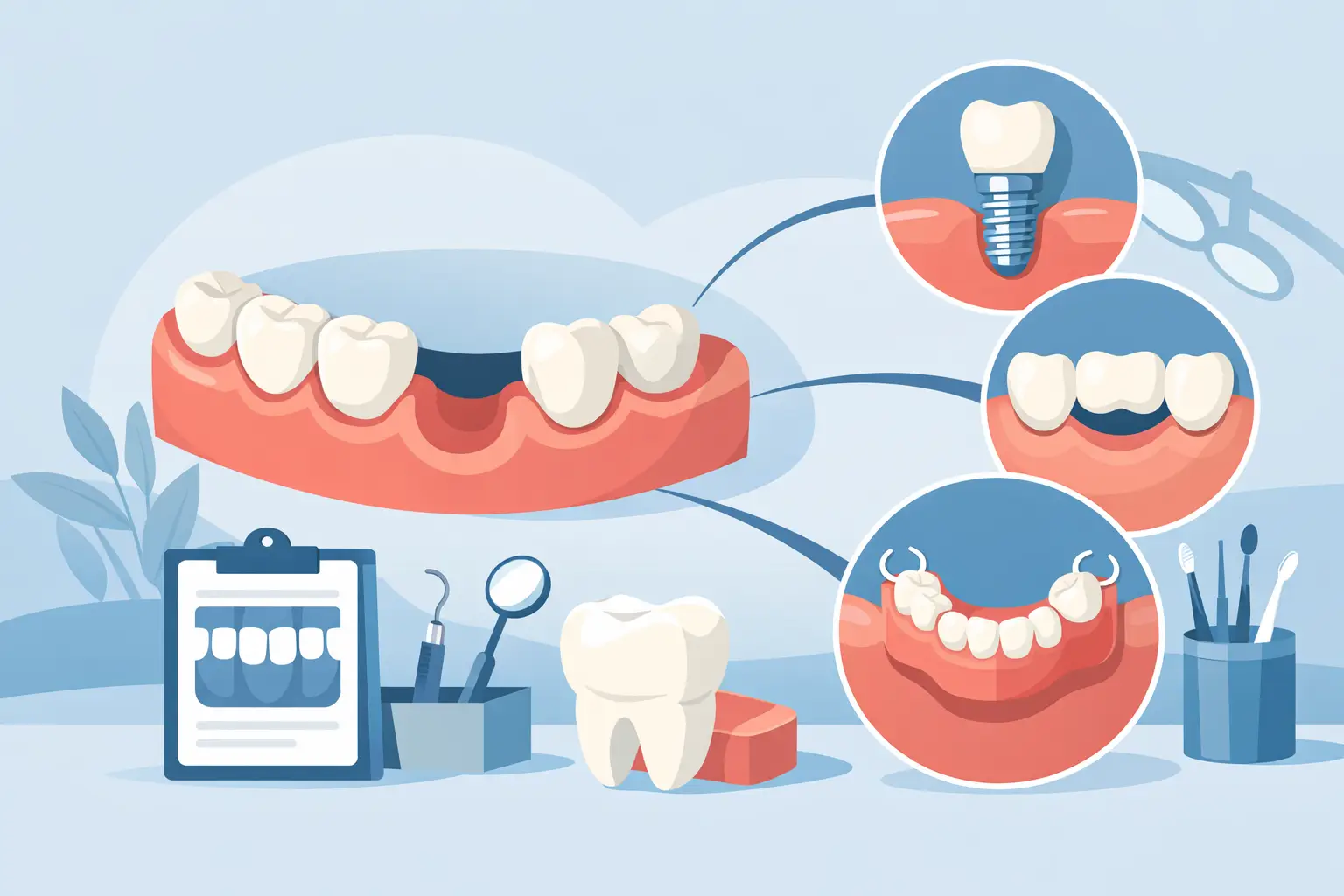
The most appropriate option usually falls into one of three categories: a dental implant, a bridge or a removable denture. Each can provide a good outcome when carefully planned and well maintained. The differences lie in how they are supported, the treatment time involved and their suitability for your mouth.
Dental implants
A dental implant replaces the root of a missing tooth with a small titanium fixture placed in the jawbone. Once it has integrated with the bone, it supports a custom-made crown, bridge or full-arch restoration. The visible tooth is designed to blend with your smile in shape, colour and proportion.
Implants are often the closest alternative to a natural tooth because they are fixed in place and do not rely on adjacent teeth for support. They can also help preserve bone in the area of the missing tooth. For a single gap, an implant crown may allow neighbouring healthy teeth to remain untouched.
However, implant treatment is a surgical procedure and requires sufficient bone, healthy gums and appropriate general health. Smoking, uncontrolled gum disease, poorly managed diabetes and heavy tooth grinding can affect risk and long-term predictability. These factors do not automatically rule treatment out, but they should be addressed openly during planning.
Treatment commonly takes several months, particularly where healing or bone grafting is needed. In suitable cases, a temporary tooth can be provided while the site heals. Modern digital planning, including three-dimensional imaging where clinically indicated, helps the team assess bone volume, nearby anatomical structures and the ideal position for the final tooth before surgery begins.
Fixed dental bridges
A conventional bridge fills a gap by attaching a replacement tooth to crowns placed over the teeth on either side. It is fixed in place, so it does not need to be removed for cleaning. Bridges can be an excellent choice when the supporting teeth already have large fillings, old crowns or damage that would benefit from coverage.
The trade-off is that healthy supporting teeth may need to be shaped to make room for the crowns. This is why a conventional bridge is not always the first choice if those teeth are otherwise sound. It also requires careful cleaning beneath the replacement tooth, using tools recommended by your dentist, to protect the gums and supporting teeth.
A resin-bonded bridge, sometimes called a Maryland bridge, is a more conservative option for certain front-tooth spaces. It has a discreet wing bonded to the back of an adjacent tooth, often with minimal or no drilling. It can look highly natural, particularly where the bite allows it, although it may be less suitable for areas exposed to heavy chewing forces.
Removable dentures
A partial denture replaces one or several missing teeth and is taken out for cleaning. Modern dentures can be far more natural-looking and refined than many people expect. They can restore appearance and function without surgery and are often a practical option where several teeth are missing or budget, health or bone availability makes implants less suitable.
Dentures do take an adjustment period. They may feel unfamiliar at first, and stability can vary depending on the shape of the jaw, the number and position of remaining teeth, and saliva flow. A well-designed partial denture should be comfortable, but it still needs regular reviews as gums and bone naturally change shape over time.
For people missing all teeth in one arch, implant-retained dentures or fixed full-arch implant bridges can offer substantially greater security. These treatments require more detailed surgical and restorative planning, but can be life-changing for patients struggling with loose dentures, failing teeth or reduced confidence when eating and speaking.
Choosing between an implant, bridge and denture
The best choice is rarely determined by one factor alone. It depends on the condition of nearby teeth, the amount of bone and gum tissue, your bite, how many teeth are missing, treatment timeframe and financial preferences. It should also reflect what you feel able to manage in terms of appointments, healing and daily cleaning.
An implant may be particularly appealing where adjacent teeth are healthy and there is adequate bone. A bridge may make more sense where neighbouring teeth need crowns anyway, or where surgery is not desired. A denture may be the most efficient way to replace multiple teeth, and can also serve as a temporary restoration during longer-term treatment planning.
Cost matters, but it is useful to consider value over time rather than focusing only on the initial fee. A lower-cost option may require more frequent adjustment or replacement, while a more involved treatment may offer longer-term function if it is maintained properly. Your dentist should explain fees, likely maintenance and alternatives clearly, without pressure.
Planning for a natural-looking result
A convincing replacement tooth is not simply the right shade of white. It needs to suit your facial features, gum line, lip movement and the character of your existing teeth. Slight translucency, surface texture and the way light reflects from the restoration all contribute to a natural result.
Function is equally important. A crown, bridge or denture that looks attractive but places excessive pressure on the bite can chip, loosen or cause discomfort. Digital scans, clinical photographs and bite records allow the dental team to plan aesthetics and function together. For complex cases, a trial smile or temporary restoration may help you assess the proposed shape and appearance before the final work is made.
If a tooth has been missing for some time, the gums and bone may have changed. Soft tissue augmentation or bone grafting may occasionally be recommended to create a stronger foundation and improve the contours around an implant restoration. These procedures add time, but may make a meaningful difference to the stability and appearance of the final result.
Looking after your replacement tooth
No replacement tooth is maintenance-free. Implants cannot develop decay, but the gums and bone around them can become inflamed without effective cleaning. Bridges require special attention beneath the false tooth. Dentures need daily cleaning and should be removed as advised to allow the tissues to rest.
Regular hygiene visits and examinations are essential, especially if you have a history of gum disease or tooth grinding. A night guard may be recommended where clenching places high forces on crowns, bridges or implants. With attentive care and timely reviews, well-planned restorations can provide dependable function for many years.
At Slievemore Dental, replacement options are planned around the whole mouth, not simply the gap. That means considering your comfort, the health of the surrounding teeth, the predictability of treatment and the smile you want to live with.
If dental anxiety has delayed seeking help, begin with a consultation rather than committing to treatment. A calm conversation, a careful examination and a clear explanation of choices can turn an uncomfortable uncertainty into a plan that feels manageable.