A missing tooth can change more than the appearance of your smile. It may affect how comfortably you chew, how clearly you speak and how confidently you laugh. When weighing up a dental bridge versus implant, the right choice is rarely about choosing the most expensive or quickest option. It is about selecting the treatment that protects your remaining teeth, suits your health and fits your long-term goals.
Both treatments can restore a gap with a natural-looking fixed tooth. However, they work in very different ways. A careful assessment of your gums, bone levels, bite, neighbouring teeth and medical history is what turns a general answer into the right plan for you.
Dental bridge versus implant: the fundamental difference
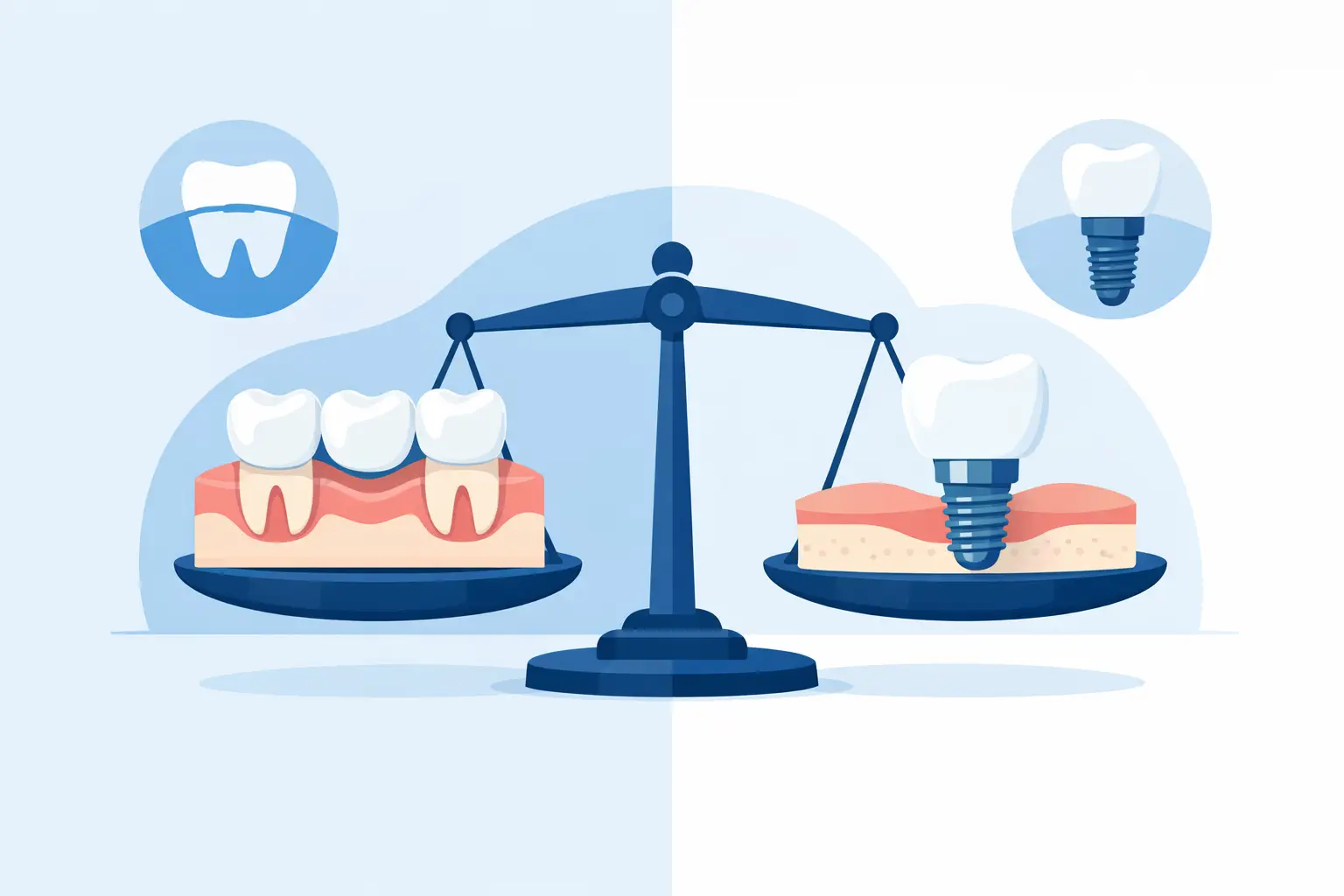
A dental bridge replaces a missing tooth by joining an artificial tooth, known as a pontic, to supporting teeth or restorations on either side of the gap. In a conventional bridge, the neighbouring teeth are prepared to receive crowns, and the bridge is made as one precisely fitted piece. Where suitable, a resin-bonded bridge may be attached more conservatively to the back of an adjacent tooth.
A dental implant replaces the missing tooth root as well as its visible portion. A small titanium implant is placed within the jawbone, where it integrates with the bone over time. Once stable, it supports an abutment and a custom crown. The result is a tooth replacement that stands independently, rather than relying on the teeth beside it.
That distinction matters. An implant can help maintain bone in the area of the missing tooth and leaves adjacent healthy teeth untouched. A bridge may be an excellent solution when an implant is not appropriate, when the neighbouring teeth already need crowns, or when a shorter treatment timeline is a priority.
When a bridge may be the better option
A bridge is not a lesser treatment. In the right clinical situation, it can be durable, comfortable and beautifully matched to your natural teeth. It is often particularly sensible if the teeth beside the gap have large fillings, fractures, old crowns or significant wear and would benefit from full coverage anyway. In that circumstance, preparing them for a bridge may form part of a wider restorative plan rather than compromising healthy enamel.
Treatment is usually completed more quickly than implant treatment. After the supporting teeth are prepared, temporary teeth can protect the area while the final bridge is designed and made. This can be valuable after a recent extraction, before an important event, or for someone who wishes to avoid a surgical procedure.
A resin-bonded bridge can be a particularly conservative option for a front tooth, especially in younger adults whose facial and jaw growth may not yet be complete. It generally requires little or no drilling of the neighbouring tooth. However, it is not suitable for every bite or every position in the mouth, and it may occasionally need to be re-bonded.
The main consideration with a conventional bridge is the long-term responsibility shared by its supporting teeth. Plaque can accumulate around bridge margins and beneath the pontic if cleaning is difficult. Decay, gum disease or a problem with one supporting tooth can affect the whole restoration. With attentive home care and regular hygiene visits, many bridges provide excellent service for years.
When an implant may be the stronger long-term choice
For a single missing tooth with healthy neighbouring teeth, an implant is often the most tooth-preserving fixed solution. There is no need to shape adjacent teeth for crowns, and cleaning around an implant crown can feel similar to cleaning a natural tooth.
Implants also offer a valuable functional advantage: they stimulate the jawbone through everyday biting forces. After a tooth is lost, the bone in that area gradually remodels and can reduce in volume. An implant does not stop every change in the mouth, but it can help preserve the bone where it is placed. This is particularly relevant in visible areas, where bone and gum support contribute to a natural tooth shape and smile line.
Implant treatment is a staged process, not an instant fix. It involves detailed digital planning, implant placement and a healing period while integration takes place. Some patients can receive a temporary tooth during treatment; others need a period without pressure on the implant. The timing depends on the extraction site, bone quality, bite and aesthetic demands.
Not everyone is immediately ready for an implant. Active gum disease must be stabilised first, and some patients need bone grafting or soft tissue augmentation to create a stable foundation. Smoking, uncontrolled diabetes, certain medications, heavy tooth grinding and inadequate oral hygiene can all influence risk and treatment planning. These factors do not automatically rule out implant care, but they deserve a candid discussion.
Cost, time and value over the years
An implant usually has a higher initial cost than a bridge because it includes surgery, specialist planning, components and the final crown. If grafting, sedation or additional imaging is required, this can add to the overall investment. A bridge generally has a lower initial fee and can be completed in fewer appointments.
Initial cost is only one part of value. A well-maintained implant may avoid treatment to healthy neighbouring teeth, while a bridge can be highly cost-effective if it restores teeth that already require crowns. Future maintenance is possible with both options. Implant crowns can wear or loosen, and implants can develop inflammation if plaque control is poor. Bridges may require replacement if a supporting tooth changes, develops decay or fractures.
The most useful question is not simply, “Which lasts longer?” Longevity depends on diagnosis, bite forces, gum health, cleaning habits, materials and regular review. A restoration should be chosen for the mouth you have now, while considering how it is likely to change over the coming decades.
Comfort, appearance and everyday care
Both bridges and implant crowns can be made to look remarkably natural. Modern digital workflows allow careful planning of tooth proportion, shade, surface texture and how the restoration meets the gum. For front teeth, the quality and thickness of the gum tissue, the position of the lip and the shape of adjacent teeth all influence the aesthetic approach.
An implant crown feels fixed and does not rely on neighbouring teeth. A bridge also feels fixed, but cleaning beneath the replacement tooth requires a little more technique. Interdental brushes, floss threaders or specially designed bridge floss may be recommended. Your dentist or hygienist can demonstrate a routine that is realistic for you, because a technically excellent restoration only succeeds when it can be kept clean.
Neither option should feel painful once treatment is complete. Implant surgery is carried out with effective local anaesthetic, and nervous patients can be supported with a gentle pace, clear explanations and appropriate comfort measures. Mild swelling or tenderness after surgery is normal and usually manageable. Bridge preparation can cause temporary sensitivity, particularly if supporting teeth are heavily restored, but a well-fitting temporary and final bridge should protect them.
How we decide which treatment suits you
A meaningful consultation goes beyond looking at the gap. Your clinician will assess the health of the teeth either side, the condition of your gums, the amount of available bone, your bite and any signs of clenching or grinding. Digital scans and radiographs, and where appropriate three-dimensional imaging, provide the detail needed to plan treatment safely and predictably.
Your priorities also matter. Some people want the most conservative option for untouched neighbouring teeth. Others need a dependable replacement within a specific timeframe, prefer not to undergo surgery, or are already planning crowns as part of full-mouth rehabilitation. There is no benefit in recommending an implant if a bridge offers the sounder solution for your circumstances.
At Slievemore Dental, complex restorative decisions can be planned across general dentistry, prosthodontic and implant expertise, so the proposed treatment considers function, comfort and aesthetics together. If implant treatment is appropriate, careful digital planning helps position the implant around the final tooth design, rather than treating surgery and smile appearance as separate concerns.
Questions worth asking at your consultation
Ask whether the teeth beside the gap are healthy, restored or likely to need crowns in future. Ask whether you have enough bone and gum support for an implant, whether grafting would be beneficial, and what temporary tooth options are available during healing. It is also reasonable to ask how your bite, grinding habits and hygiene routine may affect the result.
Finally, ask what maintenance each option will require and what happens if a complication arises. A clear explanation of the stages, fees, expected recovery and review schedule can make the decision feel far less daunting.
The best replacement tooth is one that restores your confidence without asking more of your teeth and gums than they can reliably support. A thorough, unhurried assessment will give you the clarity to move forward with confidence.