A missing tooth can change more than a smile. It may affect how comfortably you chew, how clearly you speak, the way your bite meets, and how confident you feel in photographs or conversations. The best options for missing teeth depend on where the gap is, how many teeth are involved, the health of the supporting bone and gums, and what matters most to you: a fixed solution, natural appearance, affordability, or a shorter treatment journey.
There is no single restoration that is right for everyone. A careful assessment should look beyond the visible gap to the condition of neighbouring teeth, your bite, gum health, medical history and long-term goals. With modern digital planning and specialist input where needed, treatment can be designed to restore function while achieving a result that feels secure and looks convincingly natural.
Why replacing a missing tooth can matter
Some people manage well with a gap, particularly at the very back of the mouth. However, leaving a missing tooth untreated can sometimes allow neighbouring teeth to tilt or drift into the space. The opposing tooth may also begin to over-erupt, which can alter the bite and make future treatment more complex.
Tooth loss may also reduce chewing efficiency. Where several teeth are missing, patients can unconsciously avoid certain foods, placing more pressure on the remaining teeth. After a tooth is removed, the jawbone in that area can gradually reduce in volume because it no longer receives stimulation through the tooth root. This is particularly relevant when considering future implant treatment.
Replacing a tooth is not simply an aesthetic decision. It is often part of protecting the balance, comfort and long-term health of the whole mouth.
The best options for missing teeth: an overview
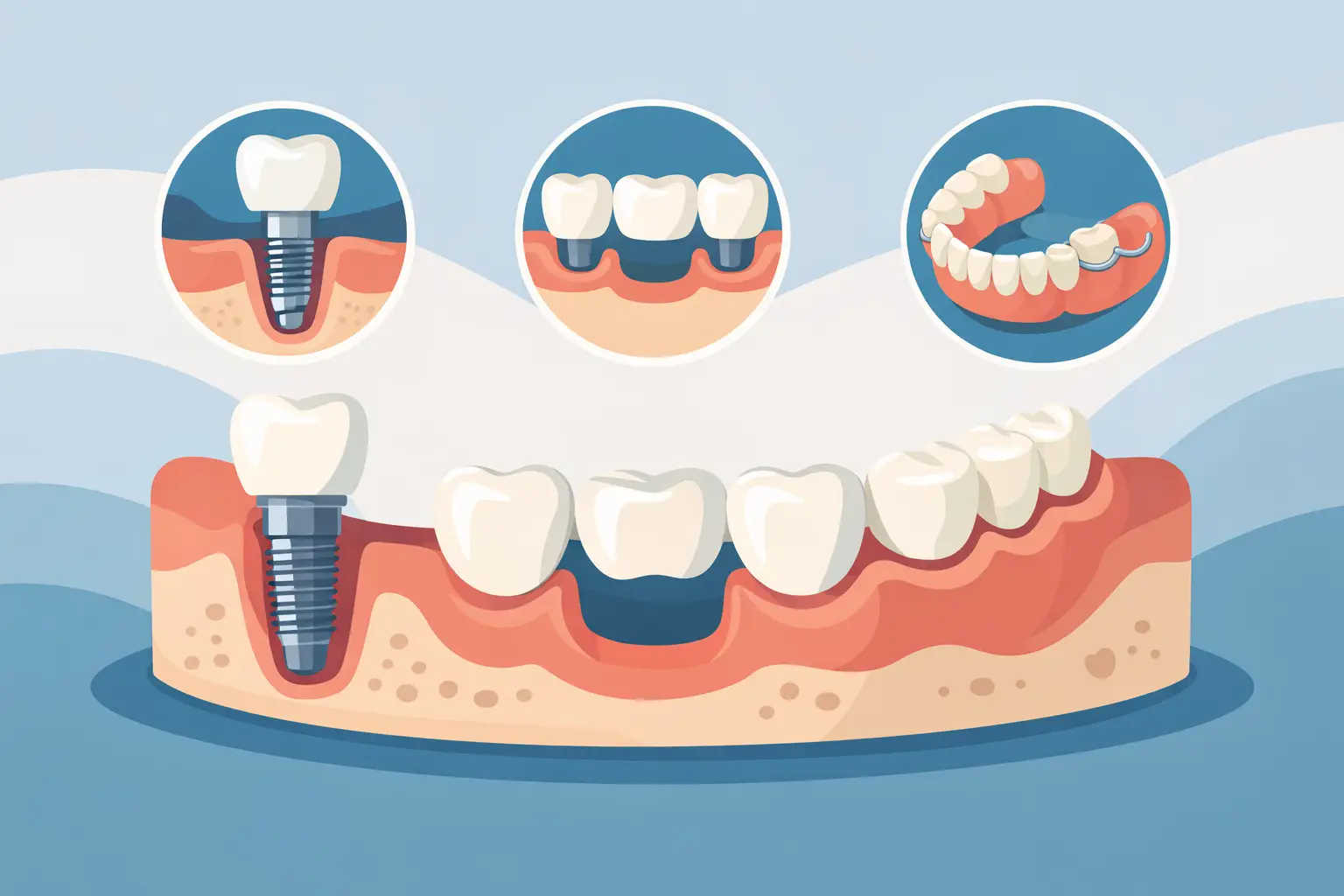
The main treatments are dental implants, fixed dental bridges, removable dentures and, in selected situations, choosing not to replace the tooth. Each has a different clinical role. The most suitable option is usually the one that respects your existing teeth and tissues while meeting your expectations for comfort, appearance and maintenance.
Dental implants
A dental implant is a small titanium fixture placed into the jawbone to act as an artificial tooth root. Once it has integrated with the bone, it can support a crown for one missing tooth, a bridge for several teeth, or a full-arch restoration for extensive tooth loss.
For many suitable patients, an implant-supported crown offers the closest replacement for a natural individual tooth. It stands independently, so the teeth either side of the gap do not usually need to be filed down. A carefully designed ceramic crown can be matched to surrounding teeth in shape, shade and translucency, creating a refined and natural-looking result.
Implant treatment takes time. It may involve scans, digital treatment planning, surgical placement, a healing period and the final restoration. Some patients need bone grafting or soft tissue augmentation before or alongside implant placement, particularly if a tooth has been missing for a long time. Smoking, uncontrolled gum disease, certain medical conditions and heavy teeth grinding can affect suitability or require additional planning.
An implant is a long-term investment rather than a maintenance-free solution. Daily cleaning around the crown, regular hygiene visits and professional reviews are essential to protect the surrounding gums and bone. When clinically appropriate and properly maintained, implants can provide excellent stability, function and aesthetics.
Fixed dental bridges
A bridge fills a gap by attaching a replacement tooth to neighbouring teeth. A conventional bridge is supported by crowns placed over the teeth on either side of the space. This can be an excellent choice where those teeth already have large restorations or crowns and would benefit from protection anyway.
Bridges are fixed in place, so they feel more stable than removable appliances and can restore chewing and appearance efficiently. They may also be completed in less time than implant treatment, since they do not require surgical healing. Modern ceramic materials allow for highly aesthetic results, particularly in visible areas of the smile.
The trade-off is that a conventional bridge usually requires preparation of supporting teeth, even when they are otherwise healthy. Those teeth carry additional load and must be cleaned carefully around the bridge to prevent decay or gum inflammation. A bridge does not replace the tooth root, so it does not preserve bone in the same way as an implant.
For a front tooth, a resin-bonded bridge can sometimes be a conservative alternative. Often called a Maryland bridge, it uses a discreet wing bonded to the back of an adjacent tooth. It generally requires little or no drilling, although it may not be suitable in every bite and can occasionally become detached.
Removable dentures
A partial denture replaces one or more missing teeth and can be taken out for cleaning. A full denture replaces all teeth in an upper or lower arch. Today’s dentures can be designed with much greater attention to tooth shape, gum contour, facial support and natural aesthetics than many people expect.
Dentures are often the most accessible way to restore multiple missing teeth, especially where implants are not suitable or where surgery is not desired. They can also be used as an interim solution while gums heal after extractions or while implant treatment is being planned.
Their limitations are mainly related to stability and adaptation. A removable denture can move during eating or speaking, particularly in the lower jaw, and it may take time to become accustomed to its feel. Changes in gum and bone shape over time can mean that a denture needs adjustment, relining or replacement.
For patients missing all teeth, implant-retained dentures can provide a valuable middle ground. The denture still comes out for cleaning, but it clicks securely onto implants, improving retention and reducing movement. Full-arch fixed implant restorations, including All-on-X treatment, may be appropriate for patients seeking a non-removable solution after detailed surgical and restorative assessment.
Leaving the gap untreated
There are circumstances where monitoring a gap is reasonable. This may apply to a wisdom tooth, a back tooth that has little impact on chewing, or a space where replacement would not improve function or comfort. The decision should be made after examining the bite and the risk of teeth drifting or over-erupting.
Choosing no treatment is still an active clinical decision, not an absence of care. Regular reviews can identify changes early and keep future options open where possible.
How to choose the right tooth replacement
The right choice begins with a comprehensive consultation, not a price list. Two people with apparently similar gaps may need very different treatment because their bone levels, gum condition, bite forces and adjacent teeth are different.
If preserving healthy neighbouring teeth is the priority, an implant or resin-bonded bridge may be preferable. If surgery is not suitable or treatment needs to be completed more quickly, a conventional bridge or denture may make greater sense. When several teeth are failing, treating one gap at a time may not be the most predictable plan. A full-mouth rehabilitation approach can assess the entire bite and create a staged route towards comfort and long-lasting function.
Cost matters, but it is helpful to consider lifetime value alongside the initial fee. A lower-cost solution may be entirely appropriate, particularly as an interim restoration. Equally, a more complex treatment may reduce the need to alter healthy teeth or replace a restoration sooner. Clear discussion of fees, treatment stages and payment options should be part of the planning process.
What a high-quality result should include
A replacement tooth should not merely fill a space. It should support a comfortable bite, healthy gums and a natural smile. Good planning considers the visible tooth, the root or support beneath it, the gum line, facial proportions and how the restoration will age alongside your natural teeth.
At Slievemore Dental, complex missing-tooth cases can be coordinated across restorative, implant and surgical expertise, with digital workflows used to improve precision and predictability. This is particularly valuable where bone loss, failing teeth, bite issues or dental anxiety make treatment feel daunting.
If you have been living with a gap for years, or have recently lost a tooth unexpectedly, you do not need to decide immediately. A calm consultation can clarify what is possible, what is necessary, and which option gives you the confidence to eat, speak and smile comfortably again.