A severely painful or infected tooth can make the decision feel urgent. Yet root canal versus extraction is rarely a simple choice between two equivalent treatments. The best option depends on whether the tooth can be predictably restored, the condition of the surrounding bone and gums, your bite, and what will be needed to keep your smile comfortable and functional for years to come.
For many patients, saving a natural tooth is the preferred outcome where it is clinically sound. In other cases, removing a tooth that cannot be restored can protect your wider oral health and create a more reliable foundation for replacement. A careful examination allows those decisions to be made calmly, with clear information rather than pressure.
Root canal versus extraction: the central difference
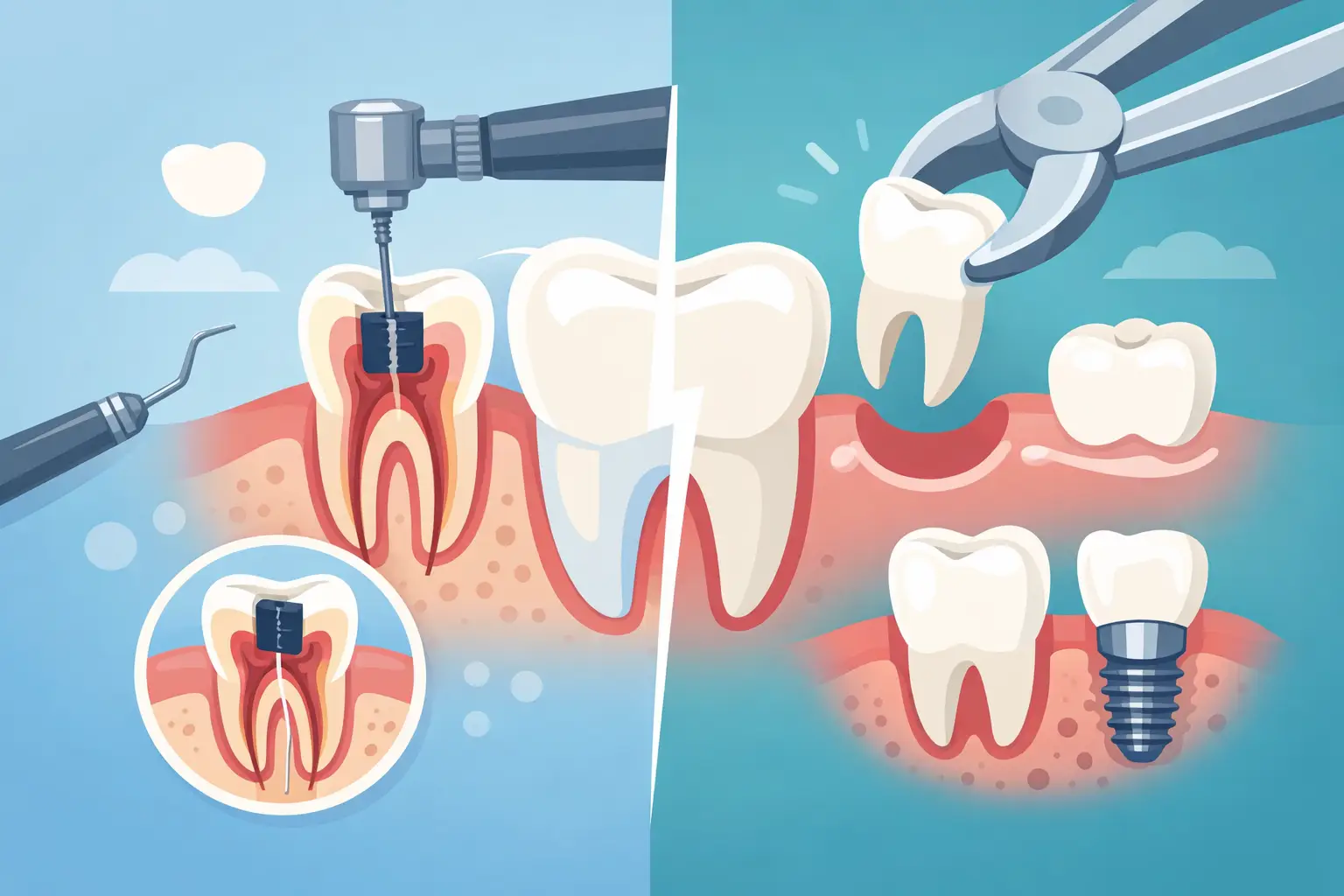
Root canal treatment aims to retain a tooth whose pulp, the soft tissue inside it, has become inflamed, infected or damaged. During treatment, the dentist removes the affected tissue, cleans and disinfects the fine internal channels of the root, then seals them. The tooth is usually restored with a filling or, particularly for back teeth or extensively weakened teeth, a crown to protect it from fracture.
Extraction removes the entire tooth, including its roots. It may be the safest recommendation when decay or fracture extends too far below the gum line, infection has caused significant destruction, periodontal disease has left insufficient support, or there is not enough healthy tooth structure for a durable restoration.
Neither approach is automatically the more comfortable, less costly or better long-term choice. Those questions depend on the individual tooth and the treatment needed after it.
When preserving the natural tooth may be appropriate
A root canal can be an excellent option when there is enough healthy tooth and root remaining to support a lasting restoration. It is commonly considered for deep decay, a large failing filling, trauma, repeated dental work, or an abscess caused by infection inside the tooth.
Keeping a natural tooth can help maintain normal chewing, preserve the shape of the jawbone around that tooth and avoid the need to replace a gap. It also avoids movement of neighbouring teeth into the space, which can affect bite alignment over time.
Modern root canal treatment is performed with local anaesthetic and careful techniques designed to prioritise comfort. Many patients are surprised that treatment feels similar to having a substantial filling once the tooth is fully numb. If dental anxiety has delayed seeking care, it is particularly helpful to say so before the appointment. A gentle, judgement-free approach and a clear explanation of each stage can make treatment more manageable.
That said, a root canal is not simply a way to avoid extraction at any cost. The tooth must have a realistic prognosis. A dentist will assess whether it can be adequately sealed, whether there is a crack in the root, and whether a crown can be placed with enough sound tooth structure to support it.
Why the final restoration matters
The root canal itself treats infection within the tooth, but it does not rebuild lost enamel or protect weakened cusps. A tooth that has been extensively decayed or has a large old restoration may be more prone to fracture afterwards, especially a molar that takes heavy chewing forces.
For that reason, the long-term plan often includes a carefully designed crown. Digital planning and precise restorative assessment help ensure the restoration fits the bite, supports function and looks natural alongside your existing teeth. When comparing costs, it is important to consider the complete treatment pathway rather than the root canal appointment alone.
When extraction may be the safer choice
Extraction can be the most responsible option when a tooth is beyond predictable repair. This may include a vertical root fracture, severe decay extending deep below the gum line, advanced gum disease with substantial bone loss, or a tooth that has failed previous treatment and cannot be reliably retreated.
Removing an unsalvageable tooth can resolve a source of pain and infection, but it also creates a gap that deserves a considered plan. For some teeth, particularly a wisdom tooth or a tooth that has no meaningful role in the bite, replacement may not be necessary. For other teeth, leaving the space can affect chewing efficiency, appearance, neighbouring teeth and the bone in the jaw.
Where replacement is advisable, the options may include a dental implant, a bridge or, in selected situations, a removable appliance. Each has different implications for treatment time, cost, maintenance and the teeth next to the space. An implant can replace the root as well as the visible tooth and may help maintain bone volume, but it requires sufficient bone and healthy gum tissue, as well as a period of healing. A bridge may provide an efficient fixed solution, although the design must be considered carefully if it involves neighbouring teeth.
Extraction is not necessarily the quicker overall route
An extraction appointment may take less time than root canal treatment, but the full journey can be longer if you choose tooth replacement. Healing, implant planning, any necessary bone or soft tissue augmentation, implant placement and final restoration all need to be factored in.
Conversely, choosing a root canal for a tooth with a poor outlook can lead to repeated treatment and eventual extraction. The aim is not to select the shortest appointment. It is to choose the option with the best balance of health, predictability, function and value over time.
How a clinician decides between root canal and extraction
A proper recommendation should begin with a detailed clinical assessment, not a quick glance at an X-ray. Your dentist will discuss symptoms, examine the tooth and gums, assess mobility and bite forces, and take appropriate radiographs. In complex cases, three-dimensional imaging may be useful to understand root anatomy, fractures, infection or bone availability.
The decision is influenced by several connected factors:
- Restorability: Is there enough healthy tooth structure above and below the gum line to support a secure restoration?
- Root condition: Are the roots intact and suitable for treatment, or is there a crack that extends into the root?
- Gum and bone support: Does the tooth have a stable periodontal foundation?
- Infection and symptoms: Can the source of infection be effectively treated, and is there swelling requiring prompt care?
- Your wider dental plan: How does this tooth fit within your bite, existing crowns or bridges, orthodontic needs and future smile goals?
Your preferences matter too. Some patients prioritise retaining their natural teeth wherever possible. Others may prefer extraction and a planned replacement when the prognosis is uncertain. A good consultation makes room for both the clinical evidence and the outcome that feels right for you.
Pain, recovery and emergency care
Neither treatment should be approached with the expectation of unnecessary pain. Local anaesthetic is used for both root canal treatment and extraction, and your dentist can advise on appropriate pain relief and aftercare. It is normal for a tooth to feel tender after a root canal, particularly if it was infected beforehand. Following an extraction, soreness and swelling are common for a few days, while the socket heals over the following weeks.
Seek urgent dental assessment if you have facial swelling, a fever, difficulty swallowing or breathing, uncontrolled bleeding, or severe pain that is not settling. Antibiotics are not a substitute for treating the cause of a dental infection. Drainage, root canal treatment or extraction may be necessary to resolve it properly.
For nervous patients, the most useful step is often to attend before a problem escalates. Early assessment can expand the range of treatments available and usually makes care more straightforward.
Questions worth asking at your consultation
Ask whether the tooth is restorable, what its expected long-term prognosis is, and what restoration it will require after root canal treatment. If extraction is advised, ask whether replacement is recommended, when it could be placed and what the complete treatment plan involves.
It is also reasonable to ask about alternatives, likely maintenance needs and how each option may affect your bite and appearance. When a tooth has a complex history, or when treatment affects a visible area or several teeth, coordinated input from restorative, endodontic and surgical clinicians can be valuable.
A painful tooth deserves timely attention, but it also deserves a decision that looks beyond today’s discomfort. With a thorough diagnosis and a carefully planned restoration or replacement, you can move forward with greater comfort, confidence and clarity.